
Compute a signed residual
Suppose a model predicts y=3x+4 and a recorded point is (5,17). The prediction at five is 19, giving residual 17−19=−2. The model overpredicts by two output units. Reversing subtraction gives a positive value and reverses that interpretation. A residual compares outputs at the same input, not two unrelated measurements.
Recover an observation
If a model predicts 24 and the residual is positive three, the actual observation is 27. Rearrange residual=observed −predicted rather than guessing the sign. A point above the fitted line has a positive residual; a point below it has a negative one. This is a vertical difference, not perpendicular distance to the line.
Compare a pattern without overclaiming
Outputs 4,8,16 at equally spaced inputs have differences four and eight, but ratios two and two. They match an exponential pattern over those observations. A few data points do not prove the unique law generating a real system. Likewise, a positive association between study time and score does not by itself isolate the effect of studying from other influences.
Transfer and check
For predicted y=2x+7, input four and residual −3, recover observed y=12. Then explain why a good prediction within the observed input range need not remain accurate far outside it. Extrapolation adds a model assumption that the observed fit alone cannot verify.
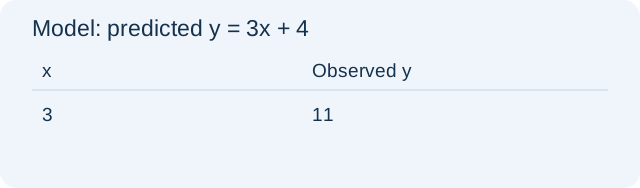
At x=3, use the model and observation table. What is the residual, defined as observed minus predicted?
 Open full-size diagram ↗
- At x=3, the model predicts 3(3)+4=13.
- The observed value is 11.
- Residual=11−13=-2; the point is below the model.
Compare the other answer choices
Subtract observed from predicted, reversing the residual sign.
Return the observed value without subtracting the prediction.
Return the predicted value instead of its error.
Explain your thinking.
Optional written extension. Self-assessed only; it does not change your automatic practice result. These are teaching criteria, not official awarded marks.
Under the same model at x=3, what observation would produce a residual of +3? Explain its position relative to the line.
This draft stays on this page only. Use paper if you want to keep your working.
Try it, then explain it.
Complete a short set without looking at the example. After each answer, explain which operation preserved the relationship and why the result makes sense.
Sources & authorship
Original Slope explanations and examples. References support the concepts; they are not the source of copied questions. Independent educator review is pending.
SAT official Problem-Solving and Data Analysis scopeOpenExamPrep SAT Math archived topic research