All examsIGCSE MathematicsFoundation path
View coverage
FREE ORIGINAL PRACTICE · ANSWERS & EXPLANATIONS

IGCSE Mathematics Practice Questions & Answers

Build exact arithmetic, algebra, geometry and data skills for Cambridge 0580 Extended foundations.

Read 10 original sample questions with worked explanations before opening the practice studio. These examples introduce selected topics from this IGCSE Mathematics foundation path.

Free access · No sign-up · No personal progress recorded on this page

What this practice covers

Cambridge Mathematics 0580 Extended foundations for examination years 2025–2027

Foundation MCQ and numeric drills; official papers require written solutions and method marks.

10 public examples400 question variants in the studio96 task families

Review status: Independent educator review and learner calibration are pending. Use these selected foundation examples alongside the coverage map and current official references.

Check the coverage map and remaining gaps
CHOOSE A STARTING POINT

Topics in this foundation path

The examples below span 4 of 4 learning domains. Counts describe the current catalog, not the exam's official weighting.

TRY A QUESTION. FOLLOW THE REASONING.

Sample questions with answers

Work out your answer first, then compare the explanation. This stable selection uses distinct task families across the available learning domains.

QUESTION 01Number

Exact number and place value

Without a calculator, evaluate 3/6 + 4/3.

  1. 7/9
  2. 2/3
  3. 7/6
  4. 11/6

Answer: 11/6

  1. Use denominator 6 for both terms.
  2. The numerator becomes 3+2(4)=11.
  3. Reduce the fraction if possible.
Compare the other answer choices
7/9

Add numerators and denominators directly.

7/6

Change the second denominator without scaling its numerator.

2/3

Multiply the fractions instead of adding them.

Reference basis: Cambridge IGCSE Mathematics 0580. These are original learning questions, not questions reproduced from the references.

QUESTION 03Geometry

Coordinates, gradients and lines

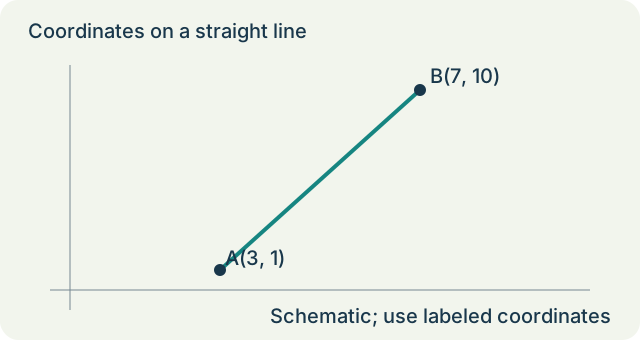
Use the coordinates labeled on the diagram. What is the gradient of AB?

A plotted at (3,1), B at (7,10), joined by a line; schematic uses labeled coordinates.Open full-size diagram ↗
  1. -9/4
  2. 11/10
  3. 9/4
  4. 4/9

Answer: 9/4

  1. Subtract y-coordinates and x-coordinates in the same order.
  2. The rise is 9 and the run is 4.
  3. Divide rise by run.
Compare the other answer choices
4/9

Invert rise and run.

-9/4

Reverse only one coordinate subtraction.

11/10

Divide sums of coordinates instead of differences.

Reference basis: Cambridge IGCSE Mathematics 0580. These are original learning questions, not questions reproduced from the references.

QUESTION 04Data

Probability with and without replacement

A bag contains 6 red and 2 blue counters. Two counters are drawn uniformly at random without replacement. Find the probability both are red.

    Write a numeric answer.

    Answer: 15/28

    1. The first red probability is 6/8.
    2. After red is removed, the second is 5/7.
    3. Multiply the two probabilities along this path.

    Reference basis: Cambridge IGCSE Mathematics 0580. These are original learning questions, not questions reproduced from the references.

    QUESTION 05Number

    Ratios and percentage changes

    A jacket costs 48 dollars after a 20% discount. What was its original price in dollars?

    1. 192/5
    2. 60
    3. 288/5
    4. 48

    Answer: 60

    1. The sale price is 80% of the original.
    2. Divide by 0.8 rather than adding 20% of the sale price.
    3. The original price is 60 dollars.
    Compare the other answer choices
    48

    Return the sale price rather than the original price.

    288/5

    Add 20 percent of the discounted price instead of undoing the discount.

    192/5

    Apply another 20 percent discount.

    Reference basis: Cambridge IGCSE Mathematics 0580. These are original learning questions, not questions reproduced from the references.

    QUESTION 07Geometry

    Angles and similar shapes

    What is each interior angle, in degrees, of a regular 6-sided polygon?

    1. 120
    2. 90
    3. 30
    4. 60

    Answer: 120

    1. The exterior turning angles total 360 degrees.
    2. Divide 360 by the number of equal angles.
    3. Subtract one exterior angle from 180 degrees.
    Compare the other answer choices
    30

    Divide a straight angle by the side count.

    60

    Return the exterior rather than interior angle.

    90

    Use n−2 as the divisor for a full turn.

    Reference basis: Cambridge IGCSE Mathematics 0580. These are original learning questions, not questions reproduced from the references.

    QUESTION 08Data

    Summaries from frequency data

    A data set contains two values equal to 6 and three values equal to 11. Find its mean.

      Write a numeric answer.

      Answer: 9

      1. Compute the frequency-weighted total.
      2. There are five observations in all.
      3. Divide the total by five.

      Reference basis: Cambridge IGCSE Mathematics 0580. These are original learning questions, not questions reproduced from the references.

      QUESTION 09Number

      Carry measurement bounds through a calculation

      A length is recorded as 3 cm to the nearest centimetre. What is its upper bound, in cm? Use round-half-up for these positive measurements.

      1. 5/2
      2. 7/2
      3. 4
      4. 3

      Answer: 7/2

      1. Add half the one-centimetre rounding unit; the upper endpoint is a limiting bound.
      2. Using the stated quantities: 3+1/2 = 7/2.
      3. Check the domain, units and whether the answer is an exact value, bound or estimate.
      Compare the other answer choices
      3

      Treat the rounded measurement as exact.

      4

      Add a whole rounding unit instead of half a unit.

      5/2

      Return the lower bound instead of the upper bound.

      Reference basis: 0580 syllabus for exams in 2025–2027. These are original learning questions, not questions reproduced from the references.

      QUESTION 10Algebra

      Sets and function notation

      Sets A and B have 14 and 16 members, and their intersection has 6 members. How many members are in A∪B?

        Write a numeric answer.

        Answer: 24

        1. Add both set counts.
        2. The overlap was counted twice, so subtract it once.
        3. The result counts every member of either set once.

        Reference basis: Cambridge IGCSE Mathematics 0580. These are original learning questions, not questions reproduced from the references.

        BUILD ON WHAT YOU NOTICED

        Turn one question into a learning route

        Start with the lesson linked to an unfamiliar topic, try a focused set in the practice studio, then return to the review cards. Your practice progress stays in this browser.

        Scope, sources and review notes

        Catalog scope record: . This records the saved content mapping, not a guarantee that every external rule is current.

        • 0580 Extended foundations for2025–2027; Core is not a separately implemented route.
        • 271 MCQ and 129 numeric learning tasks are not Cambridge paper-format simulations.
        • Eight original written extensions include self-assessment rubrics; formal marking and learner calibration are not implemented.
        • Six caption-grounded companions; selected evidence reused for distinct original teaching, full audiovisual and educator review pending.
        • Foundation pilot, not full syllabus coverage or official simulation
        • Question variants are not independent question designs
        • Independent educator review pending
        • Evidence integrity and structure checks do not establish factual or audiovisual fidelity

        Check the exam provider's current information for registration, test rules and official preparation materials. The exam guide collects the relevant official references.

        OFFICIAL REFERENCECambridge IGCSE Mathematics 0580

        Current qualification scope and syllabus links

        OFFICIAL REFERENCE0580 syllabus for exams in 2025–2027

        Assessment, topics and available exam series