
A reliable method
When counting a union, subtract the overlap once. In composition evaluate the inner function first; for an inverse undo operations in reverse order.
The common trap
Adding two set sizes counts the intersection twice. An inverse function is not the reciprocal of the original function.
Make the connection
Check a Venn diagram against the total population and verify an inverse by composing the two rules on an allowed input.
Count overlap once and compose in order
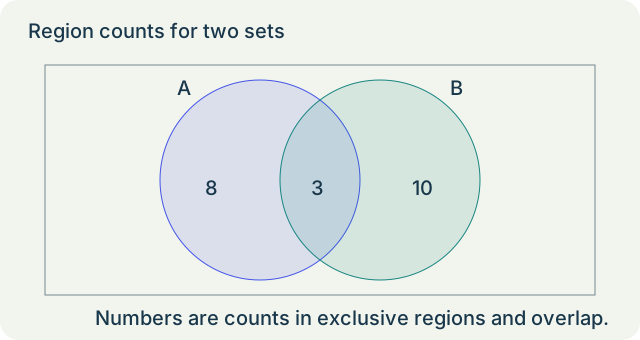
If |A|=8, |B|=7 and |A∩B|=3, their union has 8+7−3=12 members. Adding without subtracting counts the shared members twice. In a Venn diagram, the exclusive regions would contain five and four, with three in the overlap; summing regions also gives twelve. For f(x)=x+2 and g(x)=2x, g(f(3))=10 while f(g(3))=8. The notation determines the order. An inverse reverses a rule: if h(x)=3x−2, recover an input from output ten by adding two and dividing by three.
Transfer, explain and check
Solve |A|=10, |B|=9 and |A∪B|=15 for the overlap: 4. Separately check h⁻¹(10)=4 by computing h(4)=10. Explain why identical numerical results do not make these the same mathematical operation.
The Venn diagram gives counts in each region. How many members are in A∪B?
 Open full-size diagram ↗
- Add both set counts.
- The overlap was counted twice, so subtract it once.
- The result counts every member of either set once.
Compare the other answer choices
Return the intersection instead of the union.
Remove the intersection twice from the sum.
Add the overlap again rather than subtracting it.
Try it, then explain it.
Complete a short set without looking at the example. After each answer, explain which operation preserved the relationship and why the result makes sense.
Sources & authorship
Original Slope explanations and examples. References support the concepts; they are not the source of copied questions. Independent educator review is pending.
Cambridge IGCSE Mathematics 0580