
Concepts and their limits
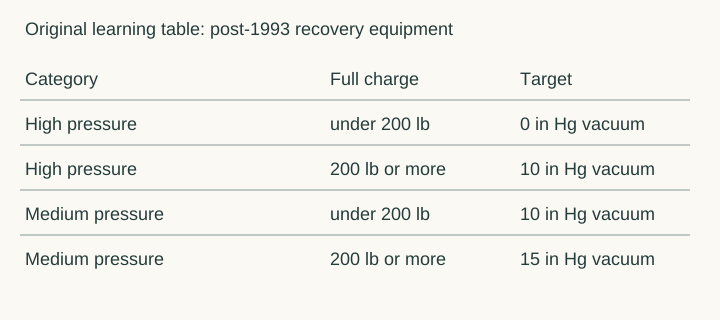
Select pressure category, the less-than-200 versus at-least-200 full-charge row, then the recovery-equipment date column. Select pressure category, the less-than-200 versus at-least-200 full-charge row, then the recovery-equipment date column. The table distinguishes the manufacture date of recovery equipment; the serviced appliance's installation date is not a substitute for that column. Very-high-pressure appliances use the specified zero-inches-Hg-vacuum table entry; isolated components are classified using the relevant appliance and full-charge row.
Worked decisions
A high-pressure stationary appliance has a full charge of 50 lb. Recovery equipment was manufactured after November 15, 1993. In EPA's general service evacuation table, which target applies? The decision is 0 inches Hg vacuum. The appliance is high-pressure and its full charge is less than 200 lb. The post-1993 column therefore gives 0 inches Hg vacuum. A medium-pressure stationary appliance has a full charge of 50 lb. Recovery equipment was manufactured after November 15, 1993. In EPA's general service evacuation table, which target applies? The decision is 10 inches Hg vacuum. The appliance is medium-pressure and its full charge is less than 200 lb. The post-1993 column therefore gives 10 inches Hg vacuum. A 300 lb high-pressure appliance is serviced with recovery equipment manufactured before November 15, 1993. Which general-table vacuum target applies? The decision is 4 inches Hg vacuum. The appliance is high pressure with a full charge of at least 200 lb. The recovery equipment is pre-November-15-1993, so the general table gives 4 inches Hg vacuum. The later-equipment value of 10 is the wrong column. A very-high-pressure appliance is serviced with post-1993 equipment. What is the listed general evacuation target? The decision is 0 inches Hg vacuum. Very-high-pressure appliances use the specified zero-inches-Hg-vacuum table entry; isolated components are classified using the relevant appliance and full-charge row.
Contrasts that change the decision
A high-pressure stationary appliance has a full charge of 199 lb. Recovery equipment was manufactured after November 15, 1993. In EPA's general service evacuation table, which target applies? Here the supported answer is 0 inches Hg vacuum. The appliance is high-pressure and its full charge is less than 200 lb. The post-1993 column therefore gives 0 inches Hg vacuum. A medium-pressure stationary appliance has a full charge of 199 lb. Recovery equipment was manufactured after November 15, 1993. In EPA's general service evacuation table, which target applies? Here the supported answer is 10 inches Hg vacuum. The appliance is medium-pressure and its full charge is less than 200 lb. The post-1993 column therefore gives 10 inches Hg vacuum. A 300 lb high-pressure appliance installed in 1988 is serviced with recovery equipment manufactured in 2010. Which date controls the equipment column? Here the supported answer is The recovery equipment's 2010 manufacture date. The table column depends on when the recovery equipment was manufactured. Therefore 2010 selects the later-equipment column; the serviced appliance’s 1988 installation date does not change that column. A very-high-pressure appliance is serviced with pre-1993 equipment. Which listed general target applies? Here the supported answer is 0 inches Hg vacuum. Very-high-pressure appliances use the specified zero-inches-Hg-vacuum table entry; isolated components are classified using the relevant appliance and full-charge row.
Transfer and self-check
A medium-pressure whole appliance has a full charge of exactly 200 lb and post-1993 recovery equipment. Which general-table row applies? At least 200 lb selects 15 inches Hg vacuum; using the under 200 lb row would incorrectly select 10.
A high-pressure stationary appliance has a full charge of 50 lb. Recovery equipment was manufactured after November 15, 1993. In EPA's general service evacuation table, which target applies?
 Open full-size diagram ↗
- The relevant stated condition is: A high-pressure stationary appliance has a full charge of 50 lb.
- Apply the relevant source rule. The appliance is high-pressure and its full charge is less than 200 lb. The post-1993 column therefore gives 0 inches Hg vacuum.
- This supports “0 inches Hg vacuum”. The alternative “4 inches Hg vacuum” uses a different condition or conclusion;the applicable rule above explains why it does not answer this case.
Compare the other answer choices
This choice (4 inches Hg vacuum) does not fit the stated conditions. Select pressure category, the less-than-200 versus at-least-200 full-charge row, then the recovery-equipment date column.
This choice (10 inches Hg vacuum) does not fit the stated conditions. Select pressure category, the less-than-200 versus at-least-200 full-charge row, then the recovery-equipment date column.
This choice (15 inches Hg vacuum) does not fit the stated conditions. Select pressure category, the less-than-200 versus at-least-200 full-charge row, then the recovery-equipment date column.
Try it, then explain it.
Complete a short set without looking at the example. After each answer, explain which evidence or rule supports your decision and why the alternatives do not fit.
Sources & authorship
Original Slope explanations and examples. References support the concepts; they are not the source of copied questions. Independent educator review is pending.
Epa Practices