
An independently authored guide to applying selected EPA reference rules to original cases. It is not a transcript, official examination or field service instruction.
Build a four-part description before looking up a number
Evacuation questions often look like number-recall questions, but the useful skill is choosing the right row and reference. Record the appliance pressure category, the full refrigerant charge, the manufacture date of the recovery equipment and whether a general requirement or a specifically qualified exception is being considered. The appliance installation date is not a substitute for the recovery-machine date. For the whole-appliance cases here,the supplied full charge determines the charge row.
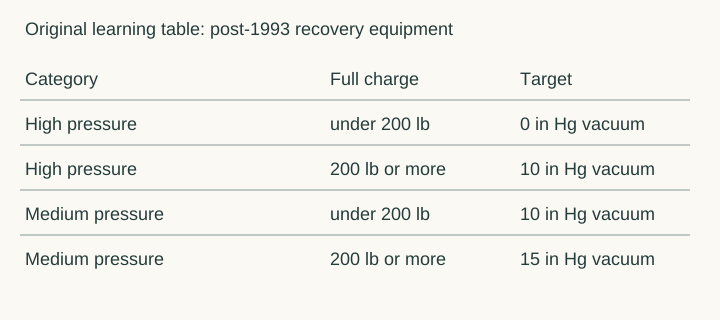
For a worked comparison, take a high-pressure appliance with a full charge of 250 pounds and post-1993 recovery equipment. The relevant general-table target is ten inches of mercury vacuum. Change the appliance category to medium pressure while preserving those other facts and the target becomes fifteen inches. Change the medium-pressure full charge to 150 pounds and the post-1993 target is ten inches. The point is not that larger numbers are always safer or always correct; the classification chooses the requirement.
Respect boundaries and measurement references
A full charge of exactly 200 pounds belongs to the at-least-200 row, not the less-than-200 row. Writing the inequality before choosing an option prevents an easy boundary error. The same discipline applies to small appliances: the percentage target depends on both recovery-equipment age and compressor function. With later equipment and a functioning compressor, the percentage route is ninety percent; a nonfunctional compressor leads to the eighty-percent branch described by EPA.
Pressure references deserve equal care. A low-pressure general-table target of 25 millimeters of mercury absolute is not 25 inches of mercury vacuum and is not 25 psig. These are different units or different reference points. In an original learning conversion, 25 millimeters equals 25,000 microns because each millimeter contains 1,000 microns. The conversion preserves the absolute reference; it does not turn the result into gauge pressure.
Treat exceptions as a checklist of prerequisites
A service exception is a conditional pathway, not permission to ignore recovery. If a leak prevents the ordinary target without substantial contamination, EPA describes isolating leaking components where possible, evacuating non-leaking parts to their specified level and taking the leaking portion to the lowest attainable level under the stated ceiling. One damaged portion does not make every intact portion exempt.
The non-major repair exception has a different set of premises. The repair must actually be non-major and must not be followed by evacuation to the environment. Under that limited pathway, high- or very-high-pressure appliances are evacuated to zero psig before opening, while low-pressure appliances are brought to zero psig by pressurization. These opposite verbs matter because the starting operating conditions differ. Do not transfer the limited exception to a major repair or omit another stated prerequisite.
Separate leakage, locating and verification
A pressure-loss observation can tell you that a system may leak without locating the leak. A locating inspection has a different purpose: identifying where leakage occurs. After a repair, an initial verification asks whether the repair was successful, typically before recharge. A follow-up evaluates the repair in the operating-condition context described by the rule. These are related steps but not interchangeable labels for one measurement.
The Section 608 ODS leak-repair summary also has a scope boundary: the full-charge threshold, refrigerant category and use category must fit. A simplified learning problem may supply a full year's measured loss and ask for loss divided by full charge, but real compliance work must use the prescribed applicable method. A historical change to one Section 608 provision cannot support the broader claim that HFC equipment has no obligations under any current program.
Finish with a defensible explanation
Before accepting a numerical answer, explain why the other table rows do not fit. If you selected a high-pressure row, identify what in the stem excludes a low-pressure chiller. If you selected the newer-equipment column, point to the recovery equipment date. If you used an exception, list its prerequisites. A correct number without that chain is fragile knowledge because a small change in the scenario may require a different answer.
For transfer practice, compare an oil-change pressure of five psig with seven psig under the stated no-greater-than-five condition. One is at the ceiling; the other exceeds it. Then compare a 20 mm Hg absolute reading with a 25 mm Hg absolute target: lower absolute pressure means deeper vacuum. Explain the reference each time. These learning comparisons develop reading and calculation habits; they do not replace hands-on training, current regulations or equipment-specific directions.
Turn the idea into practice.
Apply the rule to a new case, then explain your choice.
Practice this skillSources & authorship
Original explanations and cases informed by the linked EPA references. No third-party examination questions, video metadata or transcript are represented as authored source evidence.
Independently written teaching guide and original diagrams.
Independent educator review is pending. This guide is not an official exam paper or a video transcript.
Epa PracticesEpa QaEpa LeaksEpa Updates