
Choose a representation
Evaluate the model at the actual input before subtracting. Compare fits on the same observations using a stated loss, such as the sum of squared residuals.
Worked example: follow the quantity
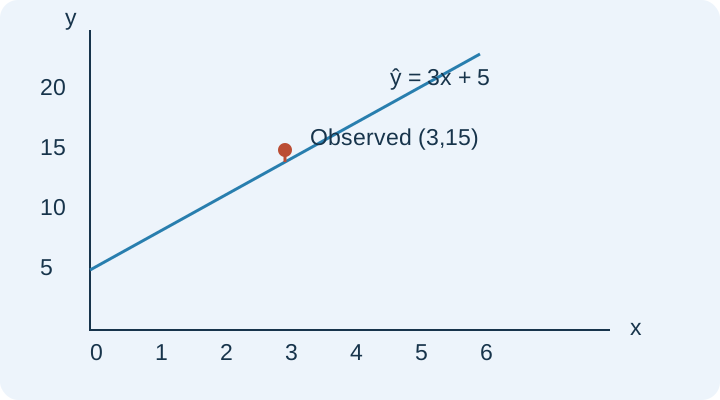
A fitted model predicts y=3 x+5. At x=3, observed y is 15. What is the residual (observed minus predicted)? Evaluate the model using the stated input. Subtract that prediction from the actual observed output. Substitute the given numbers: 15-(3 × 3+5) = 1. Therefore the requested value is 1.
Contrast a plausible mistake
For that example, the tempting answer -1 follows this error: Subtract observed from predicted, reversing the residual sign. The requested quantity is 1. Explain why the wrong operation changes the mathematical object, not merely the arithmetic.
A second representation
For x=0,1,2,3 a measured output is 5,6,9,14. Model L(x)=5+3 x and model Q(x)=5+x² are compared at x=2. By how much is L’s absolute error greater than Q’s? Use the observed output at input 2 for both models. Compare absolute errors, not model values alone. Substitute the given numbers: ((5+3 × 2)-(5+4))-0 = 2. Therefore the requested value is 2.
Transfer before checking
A fitted model predicts y=3 x+6. At x=4, observed y is 20. What is the residual (observed minus predicted)? Try without viewing the answer. Check: 2. Evaluate the model using the stated input. Subtract that prediction from the actual observed output. Substitute the given numbers: 20-(3 × 4+6) = 2.
Scope and conditions
A negative residual means the point is below the prediction. Squaring removes its sign but amplifies large misses. Correlation and a small residual do not establish causation. These original practice tasks sample the official topic; they do not certify complete coverage or a predicted ACT score.
The diagram shows one observation and the fitted line. What is the residual, defined as observed minus predicted, at the marked point?
 Open full-size diagram ↗
- Evaluate the model using the stated input.
- Subtract that prediction from the actual observed output.
- Substitute the given numbers: 15-(3 × 3+5) = 1.
- Therefore the requested value is 1.
Compare the other answer choices
Subtract only the slope term and forget the model intercept.
Report the predicted output instead of the residual.
Subtract observed from predicted, reversing the residual sign.
Try it, then explain it.
Complete a short set without looking at the example. After each answer, explain which operation preserved the relationship and why the result makes sense.
Sources & authorship
Original Slope explanations and examples. References support the concepts; they are not the source of copied questions. Independent educator review is pending.
ACT Mathematics content