All examsPSAT/NMSQT MathFoundation path
View coverage
FREE ORIGINAL PRACTICE · ANSWERS & EXPLANATIONS

PSAT/NMSQT Math Practice Questions & Answers

Connect equations, tables and real situations with focused PSAT/NMSQT Math practice.

Read 10 original sample questions with worked explanations before opening the practice studio. These examples introduce selected topics from this PSAT/NMSQT Math foundation path.

Free access · No sign-up · No personal progress recorded on this page

What this practice covers

Selected digital PSAT/NMSQT Math foundations

300 four-option questions and 100 numeric responses give practice with both response types. The mix is editorial, not an official blueprint; this is not an adaptive test or score predictor.

10 public examples400 question variants in the studio96 task families

Review status: Independent educator review and learner calibration are pending. Use these selected foundation examples alongside the coverage map and current official references.

Check the coverage map and remaining gaps
CHOOSE A STARTING POINT

Topics in this foundation path

The examples below span 4 of 4 learning domains. Counts describe the current catalog, not the exam's official weighting.

TRY A QUESTION. FOLLOW THE REASONING.

Sample questions with answers

Work out your answer first, then compare the explanation. This stable selection uses distinct task families across the available learning domains.

QUESTION 01Algebra

Translate a linear relationship

A school newspaper has 10 subscribers before a campaign. Each classroom visit adds 4 subscribers. After 6 visits, how many subscribers does the model predict?

  1. 84
  2. 34
  3. 240
  4. 24

Answer: 34

  1. The campaign adds the same count at each visit.
  2. Multiply the per-visit gain by six, then add the initial count.
  3. The requested value is 34.
Compare the other answer choices
24

Omit the initial subscribers.

84

Add the starting count at every visit.

240

Multiply initial count by the campaign gain.

Reference basis: Math specifications. These are original learning questions, not questions reproduced from the references.

QUESTION 02Advanced Math

Read a quadratic feature

The function q(x) = (x − 7)(x + 9) has two zeros. What is their distance on the number line?

Write a numeric answer.

Answer: 16

  1. Set each factor equal to zero to obtain the two roots.
  2. Subtract the negative root from the positive root to get their distance.
  3. The requested value is 16.

Reference basis: Math specifications. These are original learning questions, not questions reproduced from the references.

QUESTION 03Problem-Solving and Data Analysis

Percentages with a clear base

A reading group completes 4 of its 20 planned books. What percentage of the plan has it completed?

  1. 4
  2. 1/5
  3. 20
  4. 5

Answer: 20

  1. Use the planned count as the whole.
  2. Divide completed books by the whole and multiply by one hundred.
  3. The requested value is 20.
Compare the other answer choices
4

Report books rather than percentage.

5

Reverse total/completed and report that ratio as a percent without multiplying by 100.

1/5

Report the proportion without converting to percent.

Reference basis: Math specifications. These are original learning questions, not questions reproduced from the references.

QUESTION 04Geometry and Trigonometry

Measure areas and volumes

A square garden has side 11 meters. A square pond inside it has side 7 meters. How many square meters remain outside the pond?

Write a numeric answer.

Answer: 72

  1. Find the outer square area and the pond area separately.
  2. Subtract the pond from the entire garden.
  3. The requested value is 72.

Reference basis: Math specifications. These are original learning questions, not questions reproduced from the references.

QUESTION 05Algebra

Connect tables and equations

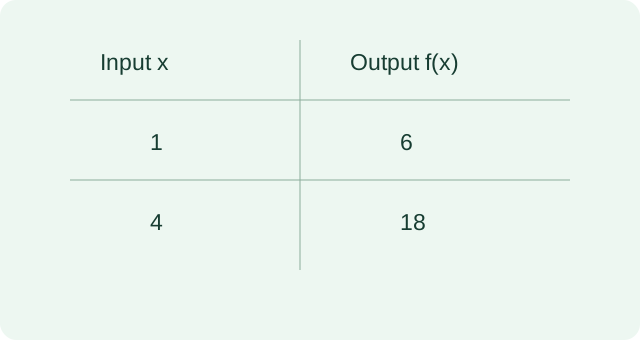
The table gives two values of a linear function f. What is f(6)?

Table: f(1)=6; f(4)=18. The function is linear.Open full-size diagram ↗
  1. 26
  2. 30
  3. 66
  4. 36

Answer: 26

  1. Compute the change per input unit using the two known points.
  2. Move five input units from the first point using that same rate.
  3. The requested value is 26.
Compare the other answer choices
30

Treat the observation at input one as input zero.

36

Assume proportionality from f(1) and ignore the second observation.

66

Use the three-unit output change as a unit slope.

Reference basis: Math specifications. These are original learning questions, not questions reproduced from the references.

QUESTION 06Advanced Math

Exponents and nonlinear rules

A culture starts with 9 cells in a model and triples every hour. How many cells does the model predict after 3 hours?

Write a numeric answer.

Answer: 243

  1. There are three complete growth periods.
  2. Multiply the initial count by three raised to the third power.
  3. The requested value is 243.

Reference basis: Math specifications. These are original learning questions, not questions reproduced from the references.

QUESTION 07Problem-Solving and Data Analysis

Ratios with visible units

A mural uses blue and white paint in a 2:3 volume ratio. If the total is 20 liters, how many liters are blue?

  1. 40/3
  2. 8
  3. 4
  4. 20

Answer: 8

  1. The total consists of five ratio parts.
  2. Blue accounts for two of those five parts.
  3. The requested value is 8.
Compare the other answer choices
4

Report one ratio part rather than two.

20

Report total paint.

40/3

Treat part-to-part 2:3 as a part-to-total fraction.

Reference basis: Math specifications. These are original learning questions, not questions reproduced from the references.

QUESTION 08Geometry and Trigonometry

Angles, similarity and right triangles

Two angles in a triangle measure 37° and 54°. What is the third angle in degrees?

Write a numeric answer.

Answer: 89

  1. The three interior angles sum to 180 degrees.
  2. Subtract both known angles from that total.
  3. The requested value is 89.

Reference basis: Math specifications. These are original learning questions, not questions reproduced from the references.

QUESTION 09Algebra

Use two conditions together

A cafeteria sold 12 lunches, each either soup or pasta. Pasta lunches numbered twice the soup lunches. How many pasta lunches were sold?

  1. 6
  2. 12
  3. 8
  4. 24

Answer: 8

  1. Represent soup by s and pasta by 2s.
  2. Their total is 3s, so find one part and multiply by two.
  3. The requested value is 8.
Compare the other answer choices
6

Split into equal groups instead of a 1:2 ratio.

12

Report all lunches.

24

Double the entire total instead of the soup part.

Reference basis: Math specifications. These are original learning questions, not questions reproduced from the references.

QUESTION 10Advanced Math

Rewrite powers and polynomial expressions

For positive x=49, what is x raised to the power 3/2?

Write a numeric answer.

Answer: 343

  1. The denominator 2 asks for the positive square root.
  2. Raise that root to the third power.
  3. Substitute the given numbers: 7^3 = 343.
  4. The requested value is 343.

Reference basis: Math specifications. These are original learning questions, not questions reproduced from the references.

BUILD ON WHAT YOU NOTICED

Turn one question into a learning route

Start with the lesson linked to an unfamiliar topic, try a focused set in the practice studio, then return to the review cards. Your practice progress stays in this browser.

Scope, sources and review notes

Catalog scope record: . This records the saved content mapping, not a guarantee that every external rule is current.

  • 400 parameterized questions across 96 families, not 400 independent designs
  • Selected PSAT/NMSQT foundations, not a complete syllabus or National Merit course
  • Independent educator review pending; no official score prediction
  • Foundation pilot, not full syllabus coverage or official simulation
  • Question variants are not independent question designs
  • Independent educator review pending
  • Evidence integrity and structure checks do not establish factual or audiovisual fidelity

Check the exam provider's current information for registration, test rules and official preparation materials. The exam guide collects the relevant official references.

REFERENCEMath specifications

Official facts and syllabus reference; no copied official question text