
Choose a representation
At a fixed input, translate each inequality into an allowed output interval. Intersect the intervals, then apply whole-number restrictions or evaluate an objective at its feasible extreme.
Worked example
Nonnegative numbers x,y satisfy 2 x+3 y≤26. If x=4, what is the greatest possible y? Substitute the fixed x into the full resource constraint. Subtract its contribution, then divide the remaining capacity by 3. Substitute the given numbers: (26-2 × 4) ÷ 3 = 6. The requested value is 6.
Contrast a wrong operation
In that example, 18 follows this error: Report unused capacity without converting it to y units. The correct requested value is 6. Explain which quantity the mistaken method is actually calculating.
Connect a second form
How many integers x satisfy |x−6|<4? The strict distance restriction is 6−4<x<6+4. Exclude both integer endpoints and count the integers inside. Substitute the given numbers: 2 × 4-1 = 7. The requested value is 7.
Transfer and check
Nonnegative numbers x,y satisfy 2 x+3 y≤31. If x=5, what is the greatest possible y? Pause before checking. Answer: 7. Substitute the fixed x into the full resource constraint. Subtract its contribution, then divide the remaining capacity by 3. Substitute the given numbers: (31-2 × 5) ÷ 3 = 7.
Boundaries of the method
Meeting one constraint does not guarantee meeting another. A strict inequality excludes its boundary even when the algebra produces an integer. This lesson samples a PSAT/NMSQT objective; its examples are original and do not claim official question status or full coverage.
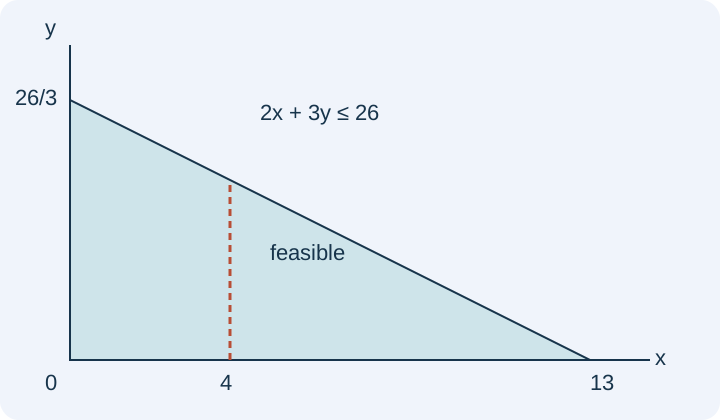
The shaded region shows the allowed nonnegative values of x and y. When x=4, what is the greatest possible y?
 Open full-size diagram ↗
- Substitute the fixed x into the full resource constraint.
- Subtract its contribution, then divide the remaining capacity by 3.
- Substitute the given numbers: (26-2 × 4) ÷ 3 = 6.
- The requested value is 6.
Compare the other answer choices
Report unused capacity without converting it to y units.
Subtract x instead of twice x.
Ignore the capacity used by x.
Try it, then explain it.
Complete a short set without looking at the example. After each answer, explain which operation preserved the relationship and why the result makes sense.
Sources & authorship
Original Slope explanations and examples. References support the concepts; they are not the source of copied questions. Independent educator review is pending.
Math specifications