FREE ORIGINAL PRACTICE · ANSWERS & EXPLANATIONS GMAT Quant Practice Questions & Answers Strengthen quantitative foundations through business contexts, exact arithmetic and clear worked solutions.
Read 10 original sample questions with worked explanations before opening the practice studio. These examples introduce selected topics from this GMAT Quant foundation path.
Free access · No sign-up · No personal progress recorded on this page
What this practice covers Selected current GMAT Quantitative Reasoning foundations; excludes Data Insights and Verbal
Five-choice original foundation problems. No calculator in official Quant. This track excludes Data Insights and Verbal, and is not an adaptive exam simulation.
10 public examples400 question variants in the studio96 task families
Review status: Independent educator review and learner calibration are pending. Use these selected foundation examples alongside the coverage map and current official references.
Check the coverage map and remaining gaps CHOOSE A STARTING POINT Topics in this foundation path The examples below span 2 of 2 learning domains. Counts describe the current catalog, not the exam's official weighting.
TRY A QUESTION. FOLLOW THE REASONING. Sample questions with answers Work out your answer first, then compare the explanation. This stable selection uses distinct task families across the available learning domains.
QUESTION 01 Arithmetic
Divisibility and integer structure A distributor has 45 pens and 75 notebooks. It makes the greatest possible number of identical kits, with every item used. How many kits does it make?
45 3 5 225 15 15 The kit count must divide both item counts. The common factor of 15 and 25 is 5, and both counts include a factor 3. The greatest kit count is 15. Compare the other answer choices 3 Returns pens per kit instead of number of kits.
5 Returns notebooks per kit instead of number of kits.
45 Assumes the smaller count divides the larger.
225 Uses a common multiple instead of a common divisor.
Reference basis: GMAT exam content ; Siyavula Grade 10 mathematics foundation reference . These are original learning questions, not questions reproduced from the references.
QUESTION 02 Algebra
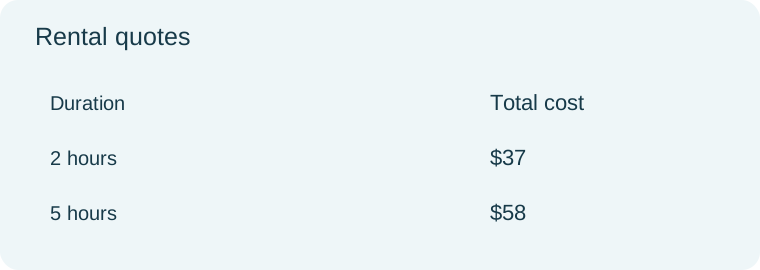
Fixed costs and break-even decisions The rental quotes in the table follow a fixed fee plus a constant hourly charge. What is the fixed fee in dollars? Dataset 1.
Open full-size diagram ↗ 7 51 37/2 37 23 23 The hourly rate is (58−37)/(5−2) = 7. Remove two hourly charges from the first total: 37 − 2(7). The fixed charge is $23. Compare the other answer choices 7 Returns hourly rate instead of the fixed fee.
37 Uses the first total as the starting fee.
51 Adds rather than removes the variable part.
37/2 Uses average cost per hour as fixed fee.
Reference basis: GMAT exam content ; Siyavula Grade 10 mathematics foundation reference . These are original learning questions, not questions reproduced from the references.
QUESTION 03 Arithmetic
Fractions as budgets and relationships What is the value of (1/3) ÷ (1/3 + 1/4)?
1/3 4/7 1/12 7/12 3/7 4/7 The denominator is (4 + 3)/12. Divide by this fraction by multiplying by its reciprocal. Cancellation gives 4/7. Compare the other answer choices 7/12 Returns the denominator expression itself.
1/3 Returns only the outside numerator.
3/7 Reverses which original reciprocal contributes to the numerator.
1/12 Multiplies the inner fractions instead of adding and dividing.
Reference basis: GMAT exam content ; Siyavula Grade 10 mathematics foundation reference . These are original learning questions, not questions reproduced from the references.
QUESTION 04 Algebra
Quadratic structure with restrictions A model gives profit P = 300 − (q − 8)² for real q ≥ 0. What is the greatest possible profit?
364 300 64 236 0 300 The squared term is at least zero. Profit is therefore at most the constant, and the bound occurs when the square is zero. At q = 8, the greatest profit is 300. Compare the other answer choices 0 Confuses a root with the maximum value.
64 Returns the squared vertex input.
236 Evaluates at zero instead of the vertex.
364 At q=0, wrongly adds the square of the vertex input to the constant instead of subtracting it, then treats this as a maximum.
Reference basis: GMAT exam content ; Siyavula Grade 10 mathematics foundation reference . These are original learning questions, not questions reproduced from the references.
QUESTION 05 Arithmetic
Price changes and simple interest An item costing $300 is marked up by 35%, then its marked price is discounted by 20%. What is its final selling price in dollars?
324 345 21 300 405 324 A 35% markup multiplies cost by 1.35. A 20% discount multiplies the marked price by 0.80. The combined factor is 1.08, giving $324. Compare the other answer choices 21 Multiplies the change percentages and omits the retained cost.
300 Assumes markup and discount cancel.
345 Subtracts the rates instead of composing their changing bases.
405 Omits the final discount.
Reference basis: GMAT exam content ; Siyavula Grade 10 mathematics foundation reference . These are original learning questions, not questions reproduced from the references.
QUESTION 06 Algebra
Budgets, bounds and integer decisions A team has a budget of $139. A service charges a fixed $12 plus $7 per report. What is the greatest whole number of reports the team can buy?
18 127 17 19 7 18 The report budget is 139−12 = 127. Divide by 7 and take the greatest integer that does not exceed the result. The maximum is 18 reports; 19 would cost $145. Compare the other answer choices 7 Charges the fixed fee separately for every report.
17 Leaves room for one more permitted report, so it is not the greatest count.
19 Rounds a noninteger affordable count up past the spending limit.
127 Returns the remaining money rather than report count.
Reference basis: GMAT exam content ; Siyavula Grade 10 mathematics foundation reference . These are original learning questions, not questions reproduced from the references.
QUESTION 07 Arithmetic
Partnerships, mixtures and ages Three partners divide $210 in the ratio 2:3:5. How many dollars does the second partner receive?
21 70 63 105 90 63 The total number of ratio parts is 10. The second partner receives 3 of those 10 parts. The amount is 210 × 3/10 = 63. Compare the other answer choices 21 Returns one ratio unit.
70 Divides equally despite unequal ratio parts.
90 Uses the other partners as denominator rather than the total.
105 Uses the third partner’s share.
Reference basis: GMAT exam content ; Siyavula Grade 10 mathematics foundation reference . These are original learning questions, not questions reproduced from the references.
QUESTION 08 Algebra
Sequences and accumulated totals An arithmetic sequence begins with 9 and has common difference 4. What is its eighth term?
72 41 33 37 184 37 From the first to the eighth term there are seven changes. Add seven copies of 4 to 9. The eighth term is 37. Compare the other answer choices 33 Counts one increment too few.
41 Counts n increments instead of n−1.
72 Adds n copies of the first term, n×a, instead of advancing to the nth term with n−1 differences.
184 Returns the sum rather than the nth term.
Reference basis: GMAT exam content ; Siyavula Grade 10 mathematics foundation reference . These are original learning questions, not questions reproduced from the references.
QUESTION 09 Arithmetic
Travel rates and relative motion A vehicle travels for 2 hours at 33 km/h and 3 hours at 53 km/h. What is its average speed, in km/h?
43 225 225/2 75 45 45 Total distance is 2(33) + 3(53) = 225 km. Total time is 5 hours. Average speed is 45 km/h. Compare the other answer choices 43 Averages speeds despite unequal travel times.
75 Divides total distance by only the second time.
225 Returns total distance instead of average speed.
225/2 Divides total distance by only the first time.
Reference basis: GMAT exam content ; Siyavula Grade 10 mathematics foundation reference . These are original learning questions, not questions reproduced from the references.
QUESTION 10 Algebra
Read functions as instructions Let f(x)=1/(x−3). What is the sum of all real inputs x for which f(f(x)) is undefined?
3 19/3 10/3 17/3 6 19/3 The inner function is undefined at x=3. The outer function also fails when 1/(x−3)=3, giving x=3+1/3. The two excluded inputs sum to 19/3. Compare the other answer choices 3 Checks only the inner function’s undefined input.
6 Finds two restrictions but drops the reciprocal correction in the second input.
10/3 Checks only the outer denominator’s restriction and misses the inner undefined input.
17/3 Moves the reciprocal term with the wrong sign when solving the outer restriction.
Reference basis: GMAT exam content . These are original learning questions, not questions reproduced from the references.
BUILD ON WHAT YOU NOTICED Turn one question into a learning route Start with the lesson linked to an unfamiliar topic, try a focused set in the practice studio, then return to the review cards. Your practice progress stays in this browser.
Scope, sources and review notes Catalog scope record: 2026-10-26 . This records the saved content mapping, not a guarantee that every external rule is current.
Selected Quantitative Reasoning foundations, not a complete GMAT course. Data Insights and Verbal are not delivered in this workspace. Fixed untimed practice, not an adaptive exam or scaled-score predictor. Editorial difficulty is uncalibrated; independent educator review remains pending. Foundation pilot, not full syllabus coverage or official simulation Question variants are not independent question designs Independent educator review pending Evidence integrity and structure checks do not establish factual or audiovisual fidelity Check the exam provider's current information for registration, test rules and official preparation materials. The exam guide collects the relevant official references.