
A reliable method
Use two observations to find change in cost divided by change in units. Substitute one observation to recover the fixed amount, then compare plans by equating totals.
The common trap
The cheapest rate does not guarantee the cheapest total. A break-even quantity is an input, while the break-even total is an output.
Check the conclusion
Substitute into both plans at the intersection and test one value on each side. State whether a fractional quantity is permitted in the context.
Contrast the cases
Rental quotes $62 for three hours and $110 for seven hours imply a $12 hourly rate: the extra four hours cost $48. Subtracting three hourly charges from $62 leaves a $26 fixed fee. Dividing $62 by three gives an average cost per hour, which includes fixed cost and does not identify the rate. Comparing 26+12h with 50+8h gives a crossing at six hours and common cost $98.
Transfer and explain
Transfer: at four hours these plans cost $74 and $82; at eight hours they cost $122 and $114. Explain why the lower hourly rate does not guarantee the lower total for every usage.
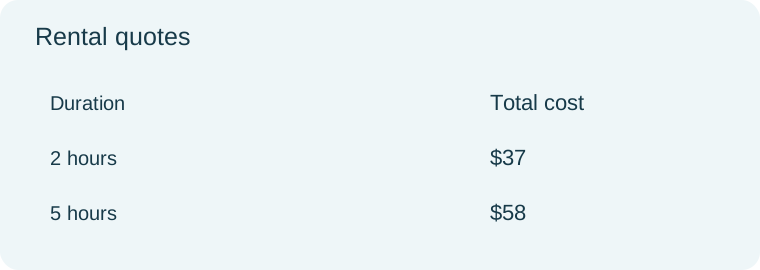
The rental quotes in the table follow a fixed fee plus a constant hourly charge. What is the fixed fee in dollars? Dataset 1.
 Open full-size diagram ↗
- The hourly rate is (58−37)/(5−2) = 7.
- Remove two hourly charges from the first total: 37 − 2(7).
- The fixed charge is $23.
Compare the other answer choices
Returns hourly rate instead of the fixed fee.
Uses the first total as the starting fee.
Adds rather than removes the variable part.
Uses average cost per hour as fixed fee.
Explain your thinking.
Optional written extension. Self-assessed only; it does not change your automatic practice result. These are teaching criteria, not official awarded marks.
Set up the relationship using the table and explain why the tempting alternative operation is wrong.
This draft stays on this page only. Use paper if you want to keep your working.
Try it, then explain it.
Complete a short set without looking at the example. After each answer, explain which operation preserved the relationship and why the result makes sense.
Sources & authorship
Original Slope explanations and examples. References support the concepts; they are not the source of copied questions. Independent educator review is pending.
GMAT exam contentSiyavula Grade 10 mathematics foundation reference