
The selected source segments illustrate rearrangement, factorization and the zero-product property.
Choose the requested feature before solving
A quadratic question can ask for a root, the sum of roots, a minimum, a parameter or a value of an expression. These requests are related but not interchangeable. Before expanding or factoring, write down exactly what the answer choices represent. Solving for both roots can be unnecessary if the question only asks for their sum, while reading a vertex does not generally tell you where the graph crosses the horizontal axis.
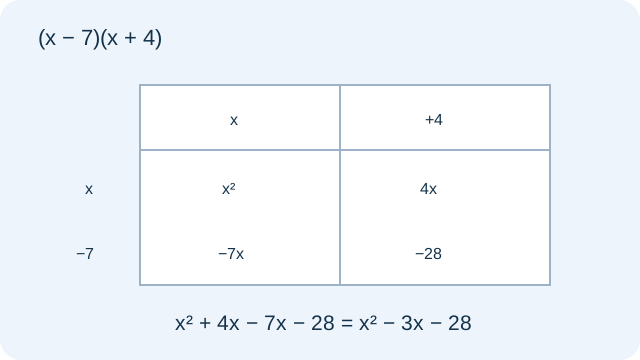
Use the independently authored example x² − 3x − 28 = 0. Two numbers with product −28 and sum −3 are −7 and 4. This suggests the factorization (x − 7)(x + 4). Expanding gives x² + 4x − 7x − 28, which returns the original expression. The expansion is a check of the middle term as well as the constant.
Apply the zero-product statement exactly
Because the product is equal to zero, at least one factor must be zero. The two candidate roots are therefore 7 and −4. Substitution checks each candidate in the original equation: 49 − 21 − 28 = 0, and 16 + 12 − 28 = 0. The check matters because a plausible-looking factorization can have a reversed sign.
If the original problem had been x² − 3x = 28, moving 28 to the left would first create the zero on the right. Do not set x equal to 28 or divide each factor separately into 28. A nonzero product does not require either factor to equal that product. This distinction is the reason the rearrangement step belongs before the zero-product step.
Translate a root into the actual answer
Suppose a problem specifies that x is positive and asks for 2x − 1. The positive root is 7, but the requested answer is 13. The negative root is rejected because of the stated restriction, not because negative numbers are inherently invalid quadratic solutions. Read the final phrase again before selecting an answer, especially when one of the choices is a root you just computed.
For a rectangle context, a negative length is also invalid. If width is x and length is x + 3 with area 40, then x² + 3x − 40 = 0 factors into (x + 8)(x − 5). The positive width is 5 and the length is 8. Check the product of the two dimensions, and report whichever dimension the question requests.
Use coefficients when they are enough
For ax² + bx + c = 0 with nonzero a, the sum of the two roots, counted with multiplicity, is −b/a and the product is c/a. In 2x² − 10x + 8 = 0, the sum is 5 and the product is 4. You can confirm the result by factoring into 2(x − 1)(x − 4), but that extra work is a check rather than a necessity.
Do not forget the leading coefficient. Reading 8 as the root product in this example would ignore division by 2. Equally, the constant from an equation not yet arranged with zero on one side may not be the relevant c. Rewrite the equation in a consistent standard form before identifying coefficients and applying a relationship.
PAUSE & TRYFor 3x² − 18x + 15 = 0, what is the sum of the roots?Reveal explanation
6, from −(−18)/3. The roots 1 and 5 confirm the sum.
Separate roots from the vertex
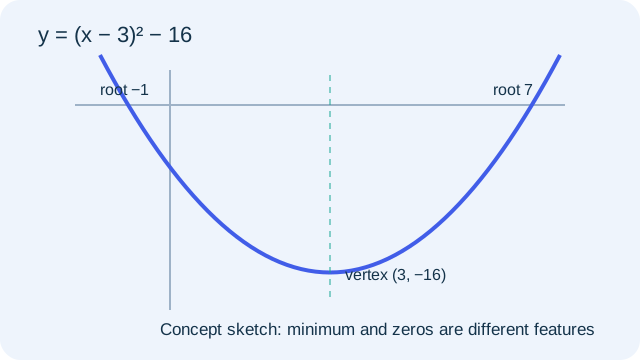
The form y = (x − 3)² − 16 has vertex (3, −16). Its minimum output is −16 because a real square cannot be negative. Its roots solve (x − 3)² = 16, so they occur at x = −1 and x = 7. The horizontal midpoint of the roots is 3, which agrees with the axis of symmetry and gives another useful check.
The original diagram shows a symmetric curve and labels the minimum separately from the horizontal-axis intersections. It is deliberately a teaching sketch rather than an exam screenshot. Use it to remember what each feature means. A minimum is an output; a root is an input whose output is zero. Interchanging these coordinate roles is a common source of answers that look numerically familiar but answer the wrong question.
Know when factoring should stop
Not every quadratic has convenient integer factors. The discriminant b² − 4ac first tells you whether a quadratic has two distinct real roots, a repeated real root or no real roots. For x² + 2x + 5, the discriminant is 4 − 20 = −16, so searching longer for real roots will not help. The appropriate next method depends on whether the problem permits complex numbers.
For this foundation set, work slowly enough to name the intended feature, arrange the equation, choose a method and check the requested output. A calculator can help verify a candidate but does not remove domain conditions or replace the meaning of the algebra. The examples here are original additions to a brief source-linked video companion, not a transcription of the source lesson or a claim of complete ACT coverage.
Turn the idea into practice.
A fresh set will help you use the relationship with different numbers.
Practice this skillEvidence & editorial note
Shared foundational video evidence from the SAT collection, explicitly reused for relevant algebra concepts. Only the listed caption ranges were reviewed for this companion. ACT examples, prose and SVGs are newly authored; source video describes SAT and is not evidence for current ACT format. Full audiovisual review pending.
Brief source synopsis; original ACT teaching extension. No transcript republication.
Caption track SHA-256: e8cd3ef004b42dc23f0cfa85bd3314b2b7a16612426c002ce58f3d5ebed9efc2
Source segment references are retained in the catalog. Full captions remain in the local research archive.