
A reliable method
State the population you are counting. Use a complement for “not,” and update the denominator after a draw without replacement.
The common trap
Independent events need not be mutually exclusive. Multiplying probabilities requires independence or an appropriate conditional probability.
Make the connection
An observed sample proportion can estimate a population proportion; it does not guarantee the exact population count.
Update the sample space
A bag contains three red and five blue counters. Initially P(red)=3/8. After a known red counter is removed without replacement, there are two red among seven total, so the next red probability is 2/7. Changing only the numerator gives 2/8 and fails to reflect the removal from the total.
Separate condition and intersection
Among 12 soccer players, five also play tennis. Conditional on playing soccer, the tennis probability is 5/12. If the whole class has 30 students, the probability a randomly chosen class member plays both sports is 5/30. Both use the same favorable group but different sample spaces.
Try, then check
A fair die is rolled. Given that the result is even, what is the probability it exceeds three? The conditional sample space is {2,4,6}; two of its three members qualify, so the answer is 2/3. Using 2/6 ignores the condition. Explain why equally likely die outcomes justify counting this way.
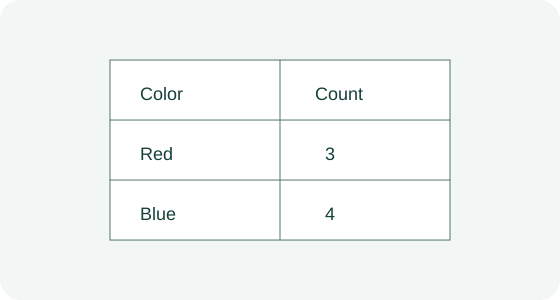
The table shows a bag’s counters. Each counter is equally likely to be drawn. What is the probability of drawing red?
 Open full-size diagram ↗
- There are 7 counters in the relevant sample space.
- 3 counters are favorable.
- P(red) = 3/7 = 3/7.
Explain your thinking.
Optional written extension. Self-assessed only; it does not change your automatic practice result. These are teaching criteria, not official awarded marks.
A red counter is removed without replacement. Find the probability that the next counter is red and explain both counts.
This draft stays on this page only. Use paper if you want to keep your working.
Try it, then explain it.
Complete a short set without looking at the example. After each answer, explain which operation preserved the relationship and why the result makes sense.
Sources & authorship
Original Slope explanations and examples. References support the concepts; they are not the source of copied questions. Independent educator review is pending.
Official mathematics skillsSiyavula Grade 10 mathematics