
A reliable method
Identify the shape and the requested measure. Write the formula with units, then substitute. Keep π exact when the prompt requests a coefficient of π.
The common trap
The Pythagorean theorem requires a right angle. A diagram that looks like a right triangle is insufficient unless the prompt supplies that fact.
Make the connection
Separate a formula fact from a diagram assumption. Mark known angles and sides before deriving an unknown length.
Use marked facts rather than appearance
A right triangle with legs 6 and 8 has c²=36+64=100, so its hypotenuse is 10. Without a stated right angle, the same two side lengths do not determine the third side. For an acute angle opposite the side 6, sine is 6/10=3/5 and cosine is 8/10=4/5.
Compare length, area and volume scales
Enlarging every length of a rectangle by 3 multiplies its area by 9. For a box, three length dimensions multiply volume by 27. A circle of radius 3 has area 9π and circumference 6π: these coefficients differ because one measure is two-dimensional and the other is one-dimensional.
Try, then check
Similar rectangles have corresponding side ratio 2:5. If the smaller area is 12, the larger area is 12(5/2)²=75. Applying only 5/2 would give 30 and scale only one dimension. Verify with a 2-by-6 rectangle enlarged to 5-by-15: the areas are 12 and 75.
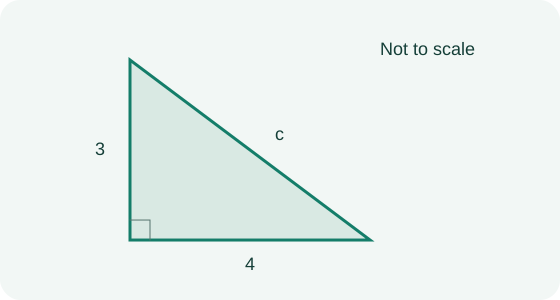
The marked angle is a right angle. What is the hypotenuse length of the triangle?
 Open full-size diagram ↗
- Use c² = 3² + 4².
- This gives c² = 25.
- The positive square root is 5.
Compare the other answer choices
Added the two legs instead of using squared lengths.
Multiplied the legs, mixing an area with a length.
Reported c² instead of its positive square root.
Explain your thinking.
Optional written extension. Self-assessed only; it does not change your automatic practice result. These are teaching criteria, not official awarded marks.
A learner adds the two legs to obtain 7. Explain the error and verify the correct length.
This draft stays on this page only. Use paper if you want to keep your working.
Try it, then explain it.
Complete a short set without looking at the example. After each answer, explain which operation preserved the relationship and why the result makes sense.
Sources & authorship
Original Slope explanations and examples. References support the concepts; they are not the source of copied questions. Independent educator review is pending.
Official mathematics skillsSiyavula Grade 10 mathematics