
Use a table deliberately
Suppose f(3)=8 and g(x)=−2f(x)+5. Then g(3)=−16+5=−11. The negative multiplier reflects the outputs across the horizontal axis before the shift. By contrast, −2[f(x)+5] gives −26 at three, because its shift occurs before multiplication. Parentheses encode a different sequence of operations.
Move a zero by solving an input condition
If f has its only zero at five and g(x)=f(x−2), then g vanishes when x−2=5, so x=7. The graph moves right by two. If the definition were f(x+2), the zero would move to three. Solving the inner equation is more reliable than memorizing the written sign.
Undo a composition in stages
Let f(t)=2t+3 and g(u)=u²+5, with g(f(t))=54 and f(t)>0. Undo the outer shift first: f(t)²=49. The sign condition selects f(t)=7, so 2t+3=7 gives t=2. Taking the negative root would give t=−5, which violates f(t)>0. A composition requires both an order of inversion and a branch decision; replacing f(t) by a bare unknown too early can hide the condition.
Transfer and check
Change the composed output to 74 while keeping f(t)>0. Then f(t)²=69, so the permitted input is t=(√69−3)/2. Verify that f(t)=√69 is positive before squaring it. Separately, a package costs $18 for four hours, then $5 per extra hour: six hours cost$28, while exactly four hours still cost$18. Select the proper branch of each rule before computing.
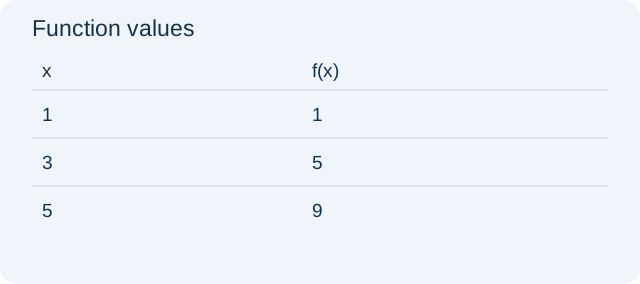
The table gives values of f. If g(x)=−2f(x)+5, what is g(3)?
 Open full-size diagram ↗
- Read f(3)=5 from the table.
- Apply the stated output transformation: g(3)=−2(5)+5.
- The result is -5; the input remains 3 throughout.
Compare the other answer choices
Omit the output scale factor.
Omit the negative sign on the scale factor.
Apply the output shift before the stretch.
Try it, then explain it.
Complete a short set without looking at the example. After each answer, explain which operation preserved the relationship and why the result makes sense.
Sources & authorship
Original Slope explanations and examples. References support the concepts; they are not the source of copied questions. Independent educator review is pending.
SAT official Advanced Math scopeOpenExamPrep SAT Math archived topic research