
The Organic Chemistry Tutor demonstrates rearranging a quadratic equation, factoring, applying the zero-product property, and adding roots. Later, the lesson uses the quadratic formula when roots are not convenient integers. The source map identifies those moments. This companion uses new examples and original diagrams; it is not a transcript or a reproduction of the video’s questions.
Make zero the target
Take the independently constructed equation x² + 5x + 1 = 15. Before factoring, move the right-hand quantity to the left. The result is x² + 5x − 14 = 0. This step is essential because the property we want to use applies to a product equal to zero.
If a product equals fourteen, neither factor has to be zero. If a product of real numbers equals zero, at least one factor must be zero. The power of factoring is that it replaces one quadratic equation with simpler linear possibilities, but only after the equation has the right form.
Use multiplication to find the factors
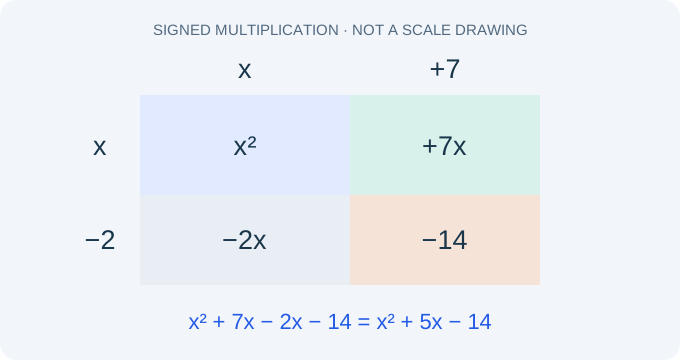
For a monic quadratic x² + bx + c, search for two numbers that add to b and multiply to c. In our example, seven and negative two add to five and multiply to negative fourteen. Therefore x² + 5x − 14 = (x + 7)(x − 2).
The original diagram shows the four terms created by multiplying the binomials. It is a signed multiplication table, not a physical rectangle with a negative length. Combining its two linear terms produces 7x − 2x = 5x. Expanding the factors is a quick way to verify the factorization.
Find both roots, then read the prompt
Set each factor equal to zero. The first gives x = −7, and the second gives x = 2. Both are solutions of the equation. Substituting either into the original expression x² + 5x + 1 produces fifteen.
A question can ask for the larger root, the positive root, the sum, or the product. Those are different answers derived from the same equation. Here the larger root is two, the sum is negative five, and the product is negative fourteen. Do not stop at the first value you calculate.
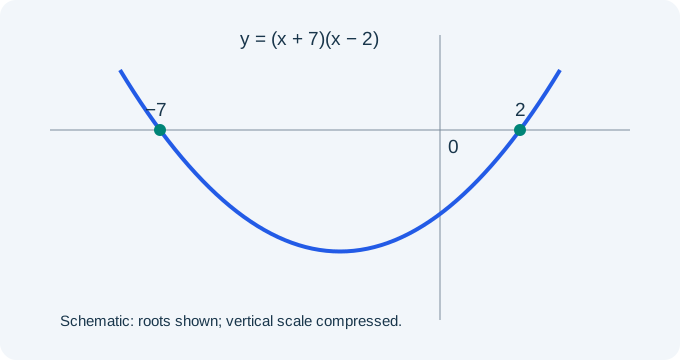
PAUSE & TRYFor this equation, what is the product of the two solutions?Reveal explanation
−14, because (−7) × 2 = −14. The product is not the larger root.
Handle a leading coefficient greater than one
Now consider 2x² + 5x − 3 = 0. Multiplying the first and last coefficients gives negative six. A pair with product negative six and sum five is six and negative one. Split the middle term as 6x − x, then factor by grouping.
The grouped expression is 2x(x + 3) − 1(x + 3). Both terms share x + 3, leaving (2x − 1)(x + 3) = 0. The roots are one-half and negative three. Check by expansion or substitution, especially when a factor has a coefficient attached to x.
Sometimes the structure is enough
For ax² + bx + c = 0, the sum of the roots is −b/a and their product is c/a. For the preceding equation, the sum is −5/2. That agrees with 1/2 − 3. If only the sum is requested, this relationship avoids solving for each root individually.
This is not permission to ignore the leading coefficient. The coefficient b alone is not generally the negative sum of the roots. Dividing by a matters whenever the quadratic is not monic. Keep the original signs attached to the coefficients when substituting.
PAUSE & TRYWhat is the sum of the roots of 3x² − 12x + 2 = 0?Reveal explanation
4. Use −b/a = −(−12)/3; the individual roots are unnecessary.
Know when factoring is the wrong tool
Not every quadratic has simple rational factors. For x² − 2x − 1 = 0, the discriminant is eight, which is not a perfect square. The quadratic formula gives 1 + √2 and 1 − √2. Searching endlessly for integer factor pairs would waste time.
The discriminant also predicts how many distinct real roots exist. A positive value means two, zero means one repeated root, and a negative value means no real roots. This can answer a question about the number of solutions without calculating the roots at all.
A compact checking routine
First, make sure the rearranged equation is equivalent to the original. Next, expand the factorization or substitute the proposed roots. Finally, compare the computed quantity with the wording of the prompt. These checks catch different errors: moving a constant incorrectly, changing a sign in a factor, and answering the wrong question.
Try the quadratic practice set after this article. It includes root selection, root sums, a vertex minimum, and a repeated-root condition. The graphs illustrate structure, while the algebra supplies exact values. Neither representation needs to do every job.
Turn the idea into practice.
A fresh set will help you use the relationship with different numbers.
Practice this skillEvidence & editorial note
Automatic captions omit several minus signs in the source. The original worked examples below were checked algebraically instead of copying those caption equations. Full audiovisual review is pending; the article does not claim a word-for-word reconstruction.
Brief source synopsis; original teaching text, examples, and SVG diagrams.
Caption track SHA-256: e8cd3ef004b42dc23f0cfa85bd3314b2b7a16612426c002ce58f3d5ebed9efc2
Source segment references are retained in the catalog. Full captions remain in the local research archive.