
The inspected early captions explain marking probabilities on a tree and multiplying along a selected path. The source demonstrates a spinner and a dice-and-coin game. This original companion transfers those ideas to counter selections with changing counts.
A branch is a conditional question
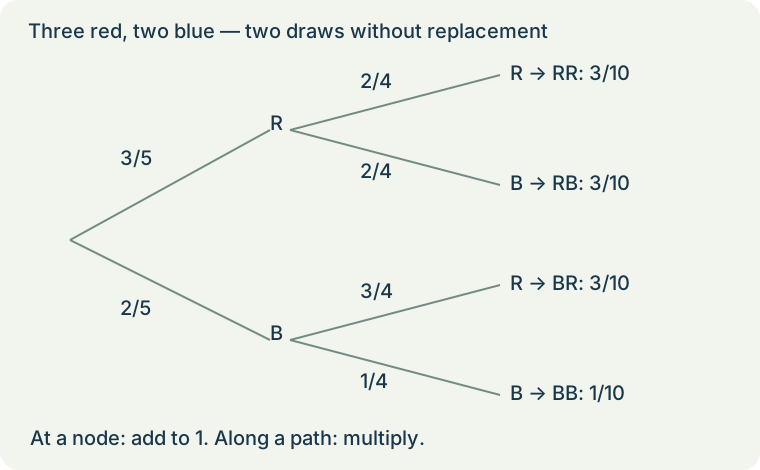
Start with an original experiment: a bag contains three red counters and two blue counters. Draw two counters uniformly at random without replacement. Before drawing a tree, name the possible first outcomes, red and blue, and assign their probabilities three fifths and two fifths. These branches leave the same starting point, so they must add to one. A branch probability describes what can happen next, given the outcomes already on its path.
If the first counter is red, the remaining bag contains two red and two blue counters. If the first is blue, it contains three red and one blue. Those are different second-stage situations. Drawing both continuations makes the changing sample space visible and prevents the original denominator five from being reused automatically. The original diagram below records all four paths rather than only the path requested by one question.
Multiply along a complete path
For two reds, follow the red branch and then the red continuation. The probability is (3/5)(2/4)=6/20=3/10. The second numerator and denominator both changed because one red counter was removed. Using (3/5)(3/5) would describe replacement before the second draw, which is a different experiment.
The inspected source captions explain labeling branches and multiplying probabilities along a route through a tree. The video’s examples involve a spinner and a dice-and-coin game; our counter experiment is original teaching that transfers the same tree-reading method to changing counts. The multiplication rule uses a second probability appropriate to its branch. It does not require the two draws to be independent, provided the conditional branch probability has been updated correctly.
PAUSE & TRYAfter a blue first draw, what is P(red next)?Reveal explanation
3/4: three red counters remain among four total counters.
Add mutually exclusive paths for an either-order event
Exactly one red can occur as red then blue or blue then red. The first path has probability (3/5)(2/4)=3/10. The second has probability (2/5)(3/4)=3/10. A single trial cannot follow both full paths, so their probabilities add to give six tenths, or three fifths. Reporting three tenths answers only one order, not the stated event.
Do not replace the two path calculations with a vague instruction to add whenever the word or appears. First confirm that the events you are adding are mutually exclusive. If they overlap, simple addition double-counts the overlap. Complete outcome paths of this two-draw tree are exclusive, making addition safe here. A labeled tree shows why the arithmetic rule applies, which is valuable evidence in a written response.
Use a total-probability check
The fourth path is two blues, with probability (2/5)(1/4)=1/10. The four terminal probabilities are therefore 3/10, 3/10, 3/10 and 1/10. Their sum is one, so the complete experiment has been accounted for. If your total exceeds one, look for a repeated path or an incorrect branch probability. If it is below one, look for a missing possibility before assuming a rounding issue.
The complement method provides another check. At least one red is everything except two blues, so its probability is 1−1/10=9/10. Adding the other three paths also gives 9/10. This second method checks the event interpretation as well as the arithmetic. Exactly one and at least one differ because the latter also includes two reds.
PAUSE & TRYWhich path is excluded by “at least one red”?Reveal explanation
Only BB. RR is included, unlike in “exactly one red”.
Replacement and conditional selection change the experiment
With replacement, each draw starts with the same three-red, two-blue composition. The two-red probability becomes (3/5)²=9/25. This is larger than 3/10 because a red first draw no longer depletes the red population before the next selection. Explain that mechanism rather than merely observing that the final fractions differ.
Now suppose you are told that the first counter was blue and asked about the second. The relevant subtree contains three red and one blue, so the answer is three quarters. Multiplying by the initial blue probability would answer the joint question that both events occur, not the conditional question after the first event is already known. Identify the sample space implied by the wording before choosing a denominator or path.
Show method without claiming an official mark scheme
A reviewable written solution labels outcomes, labels each branch with the correct fraction, identifies the required paths, performs multiplication and then adds only when the event includes multiple exclusive paths. Keep exact fractions until the requested final form. A result such as three fifths can also be written as 0.6 or 60 percent, but it must stay on the probability scale from zero to one.
The attached written extensions on this site provide original method-point checklists for self-assessment. They are not official Cambridge mark schemes and do not automatically grade handwritten reasoning. This companion is grounded in the identified early caption ranges; full audiovisual review is pending. Automatic captions sometimes distort a spoken fraction, so the original counter calculations above have been checked independently rather than copied from a possibly corrupted subtitle.
Turn the idea into practice.
A fresh set will help you use the relationship with different numbers.
Practice this skillEvidence & editorial note
Newly acquired real automatic captions; selected early caption ranges read. The counter example and tree are original, independently calculated teaching rather than a copied source example. Full audiovisual and educator review remain pending.
Original teaching with brief source synopsis.
Caption track SHA-256: 35739e5f7b2fc80f95cbb72db6056a5cd2220cdf0118b952cd34ce3ce82ead4a
Source segment references are retained in the catalog. Full captions remain in the local research archive.