
The inspected captions explain measurement intervals and operation-dependent bounds. The examples and illustrations below are independently authored.
Begin with what the measurement actually says
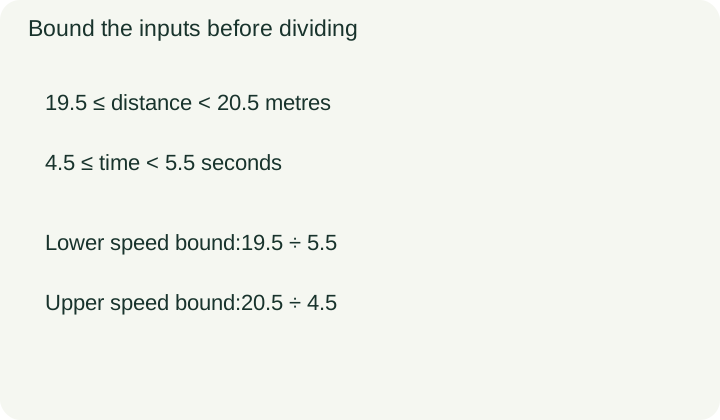
A measured distance of 20 metres to the nearest metre does not mean that the distance is exactly 20. Under the round-half-up convention used here for positive measurements, it means 19.5≤d<20.5. The lower endpoint is included and the upper endpoint is excluded. A separate time of 5 seconds to the nearest second means 4.5≤t<5.5. These intervals carry information that the rounded centre values alone cannot express. Write them before calculating speed, area or any other derived quantity. The figure keeps the two measurement intervals separate so that their endpoints can be chosen for the operation being performed.
A quotient needs opposite endpoint choices
Speed is distance divided by time. To make this positive quotient as small as possible, use the smallest permitted distance and the largest limiting time. The lower bound is 19.5/5.5=39/11 metres per second, approximately 3.545. To obtain the upper bound, use 20.5/4.5=41/9 metres per second, approximately 4.556. Dividing both lower endpoints would give a speed, but it would not give the lowest possible limiting speed. A smaller positive denominator increases a quotient. The endpoint selection follows that behavior, rather than a rule that simply matches the words lower with lower.
PAUSE & TRYWhich inputs give the upper speed bound for 20 m and 5 s rounded to the nearest units?Reveal explanation
Use20.5/4.5=41/9m/s.
Separate a bound from an attained value
In this example neither extremal speed bound is attained. The lower one requires t=5.5, which is outside the permitted time interval, while the upper one requires d=20.5, which is outside the distance interval. The bounds still describe the tight limiting range. This distinction becomes important when writing an inequality or interpreting the word maximum. A question may ask for an upper bound even though no admissible measurement produces exactly that value. Keep exact fractions until the final requested rounding stage; rounding a bound inward can accidentally exclude a possible value that the original interval allowed.
Multiplication behaves differently for positive measurements
Suppose a rectangle has length 12 cm and width 4 cm, each rounded to the nearest centimetre. Then 11.5≤L<12.5 and 3.5≤W<4.5. Because both dimensions are positive, the lower area bound is 11.5×3.5=40.25 square centimetres. The upper bound is 12.5×4.5=56.25 square centimetres. The rounded-centre calculation 12×4=48 is an estimate, not a boundary. Adding and subtracting one half from 48 would not recover the area interval, because the uncertainty belongs to each measured dimension before multiplication. The source captions make this order of work explicit; the dimensions and worked arithmetic here are original.
Subtraction also mixes endpoints
Let two positive masses be recorded as 30 kg and 8 kg, each to the nearest kilogram. To bound their difference, start with 29.5≤A<30.5 and 7.5≤B<8.5. The upper difference bound is 30.5−7.5=23 kg: take as much as possible and subtract as little as possible. The lower bound is 29.5−8.5=21 kg. Subtracting the two upper bounds would give 22, the central difference, and would miss the uncertainty range. An original transfer question asks for the upper bound of the difference between 18 cm and 5 cm, both to the nearest centimetre. The answer is 18.5−4.5=14 cm.
PAUSE & TRYFind the upper bound of 18−5 when each length is rounded to the nearest cm.Reveal explanation
18.5−4.5=14cm.
Use conditions rather than memorizing an unrestricted table
The simple multiplication and division endpoint rules above rely on positive quantities, and division also requires a denominator bounded away from zero. If an interval crosses zero or includes negative values, reason from the operation and examine the possible endpoint combinations instead of extending the positive-only rule automatically. For IGCSE measurement questions, lengths and positive elapsed times often provide the needed conditions, but they should still be named. A complete written answer records the original intervals, explains the endpoint choice, performs the calculation and states units. Those four parts show that a correct-looking number arose from the right mathematical question.
Check understanding and evidence scope
For a final check, a distance is 10 metres to the nearest metre and a time is 2 seconds to the nearest second. The upper speed bound is 10.5/1.5=7 metres per second, while the lower bound is 9.5/2.5=3.8. Explain why using the same endpoint direction for numerator and denominator fails. The selected source captions were read for interval construction, subtraction and positive quotient rules. Automatic captions sometimes misrecognise numbers, so the original examples here were separately calculated. Full audiovisual and educator review remain pending; the article does not claim that all later source examples were inspected.
Turn the idea into practice.
A fresh set will help you use the relationship with different numbers.
Practice this skillEvidence & editorial note
Actual selected captions read. GCSE teaching method mapped to 0580 Extended; source is not an official Cambridge video. New caption acquisition. Full audiovisual and educator review pending.
Original teaching companion with brief source synopsis.
Caption track SHA-256: 10c52983228fabdabd6d896e99f05b872455199835e2de027fd652dd18d1de5c
Source segment references are retained in the catalog. Full captions remain in the local research archive.