
The selected source explains complement reasoning and the distinction between independence and overlapping events. Original examples below make independence and the sample space explicit.
Read the event as a set of outcomes
Probability questions often become difficult before any arithmetic begins. The phrases exactly one, at least one, both and either describe different sets of outcomes. For three trials, at least one success includes one, two and three successes. Exactly one includes only three arrangements: success first, second or third, with failures elsewhere. Naming these outcomes makes it easier to decide whether adding cases or taking a complement will be shorter. A formula is useful only after the event is clear.
Take a complement when failure is simpler
Imagine two independent tests, each with success probability one third. The probability of failing one test is two thirds. Failing both has probability four ninths because the trials are independent. Therefore the probability of at least one success is one minus four ninths, or five ninths. This is not the probability of two successes, which is one ninth. It is also not simply two thirds: adding the two single-test success probabilities counts the both-success outcome twice.
Check the complement by disjoint cases
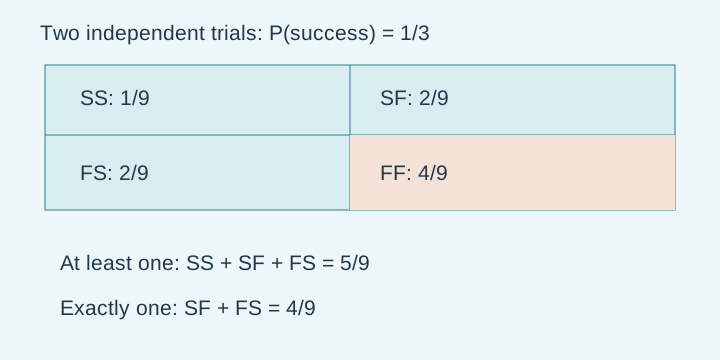
A small outcome diagram provides an independent check. The possibilities are SS, SF, FS and FF, with probabilities one ninth, two ninths, two ninths and four ninths. The first three belong to at least one success, and they sum to five ninths. Exactly one success includes only SF and FS and has probability four ninths. The complement method is efficient because FF is the only excluded case; the case diagram explains why the subtraction produces the desired event.
Make independence an explicit condition
Multiplying two marginal probabilities is justified here by independence. Without that condition, two tests could succeed together unusually often or almost never. In general P(A and B)=P(A)P(B given A). Independence permits replacing the conditional factor with P(B). This distinction also explains why a draw without replacement needs updated counts. Removing a red token changes the composition of the remaining bag, whereas replacing and remixing it preserves the original proportions under a uniform random-draw model.
Distinguish independence from mutual exclusion
Let A be heads on the first fair coin and B be heads on a second independent fair coin. They can occur together, and their intersection has probability one quarter. They are independent but not mutually exclusive. In contrast, on one coin toss, heads and tails cannot occur together. They are mutually exclusive but are not independent because knowing heads occurred makes tails impossible. The words describe different relationships, so neither can be substituted for the other just because both sound like events are separate.
Use overlap to recover an unknown probability
Suppose independent events A and B satisfy P(A)=one quarter and P(A or B)=one half. Write one quarter plus p minus p divided by four equals one half. Subtracting one quarter leaves three quarters of p equal to one quarter, hence p=one third. Verify the intersection: one quarter times one third is one twelfth. The union is then three twelfths plus four twelfths minus one twelfth, or six twelfths. The result also lies between zero and one, as a probability must.
Contrast exactly one across three trials
For three independent trials with success probability one quarter, exactly one success has probability three times one quarter times three quarters squared, or twenty-seven sixty-fourths. The factor three counts its possible positions. At least one success instead has probability one minus three quarters cubed, or thirty-seven sixty-fourths. The difference ten sixty-fourths consists of two-success and three-success outcomes. Writing the qualifying arrangements prevents the common error of applying the complement of none to a question that asks for exactly one.
Explain the method before checking the number
When reviewing an answer, give both an event explanation and an arithmetic check. For complement reasoning, name the event that was subtracted. For multiplication, state whether the factors are independent probabilities or successive conditional probabilities. For a union, identify the overlap removed once. These short explanations are more informative than saying use the probability formula. They also transfer to unfamiliar contexts: the objects may be tokens, visits or tests, but the event relationships and the conditions that justify the operations remain the same.
PAUSE & TRYTwo independent trials have success probability 1/4 each. What is the probability of exactly one success?Reveal explanation
2×(1/4)×(3/4)=3/8; the two possible success positions are disjoint.
Turn the idea into practice.
A fresh set will help you use the relationship with different numbers.
Practice this skillEvidence & editorial note
New probability source used by this companion. Selected caption ranges read; original examples and figures; full audiovisual review not performed.
Caption track SHA-256: fabe8ef013e3eae0c9a555a1333805753dca6b8b5d74645061045965ef0e96f2
Source segment references are retained in the catalog. Full captions remain in the local research archive.