
The source contrasts fraction-comparison strategies: common denominators, cross products and benchmarks near one half.
Choose a comparison, not a decimal expansion
Comparing two fractions asks for an ordering. It does not necessarily ask for either decimal value. This distinction creates a useful decision before calculation: can a benchmark, a common denominator, or a short product comparison settle the ordering? Choosing among these methods is part of quantitative reasoning. A long division that is perfectly accurate may provide far more information than the question needs.
The new source video discusses common denominators, cross products and comparisons with one half. This companion uses different examples and adds sign conditions and GRE comparison logic. The captions were read across the indicated ranges, but the complete audiovisual presentation was not reviewed. Automatic transcription sometimes corrupts fraction notation, so the arithmetic here is authored and checked independently rather than copied from caption text.
Use a benchmark to separate quantities
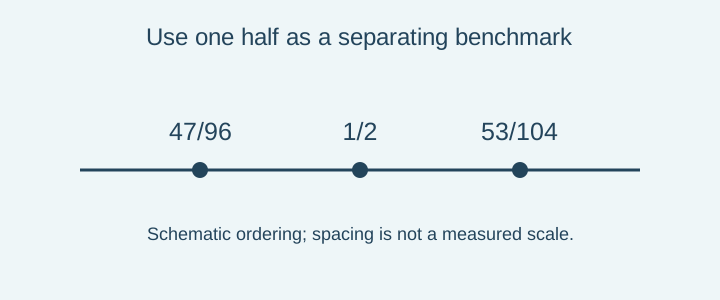
Compare 47/96 with 53/104. Twice forty-seven is ninety-four, which is less than ninety-six, so the first fraction is less than one half. Twice fifty-three is one hundred six, which is greater than one hundred four, so the second fraction is greater than one half. The benchmark lies strictly between the quantities. No multiplication of two large denominators is needed.
The diagram records the ordering rather than pretending to be an exact scale drawing. If both fractions lay below one half, this particular benchmark would not settle which was larger. It would supply a bound for both, not an ordering between them. A successful shortcut needs a conclusion that follows from the comparison; an approximate label such as “near one half” is not enough.
Switch methods when the benchmark cannot decide
Now compare 5/12 with 7/16. Both lie below one half, so use an exact comparison. With positive denominators, cross multiplication compares five times sixteen with seven times twelve. Those products are eighty and eighty-four. Therefore 5/12 is smaller. Equivalently, a common denominator of forty-eight gives 20/48 and 21/48. The two methods are different presentations of the same arithmetic.
When a common denominator is easy to recognize, writing both fractions over it can be clearer than carrying out unrelated products. When the denominators have no convenient small common multiple, cross products may be shorter. Neither method is universally best. Choose the representation that reduces the computation while preserving the sign and the exact relationship.
Normalize signs before multiplying inequalities
The ordinary cross-product shortcut assumes positive denominators, or more generally a positive product of the denominators. If that product is negative, multiplication reverses an inequality. A reliable beginner routine is to rewrite each fraction with a positive denominator first. For instance, 3/−8 becomes −3/8. Comparing that with −2/5 then compares −15/40 and −16/40, so −3/8 is greater.
This example also shows why comparing only numerators can fail. Negative fifteen is greater than negative sixteen, even though fifteen has a smaller magnitude than sixteen. If one fraction is positive and the other negative, signs alone settle the ordering and further multiplication is unnecessary. Zero denominators are excluded entirely; they do not represent exceptionally large fractions.
Translate the result into a GRE relationship
For fixed fractions, an exact comparison gives a fixed relationship. For variable fractions, the allowed domain can change everything. If x is positive, compare x with 1/x. At x = 2, the first is larger; at x = 1/2, the second is larger. Both values meet the condition, so no single ordering is forced. Two admissible counterexamples are enough to establish that conclusion.
If the condition is strengthened to x greater than one, then x² is greater than one. Dividing by positive x shows x greater than 1/x. The extra condition has removed the counterexample. Do not replace a domain with one convenient number, and do not choose an indeterminate relationship merely because a variable appears. The question is whether the relationship is fixed across every permitted value.
Practise a method choice and explain it
Compare 39/80 with 41/80. Equal positive denominators make the larger numerator decisive. Compare 49/100 with 51/100: one half separates them immediately. Finally compare 4/9 with 5/11: the cross products are forty-four and forty-five, so the first is smaller. For each pair, name why the chosen method is sufficient rather than simply stating that it is faster.
End with two checks. First verify that signs, nonzero denominators and strict versus non-strict relationships were handled correctly. Then read which quantity was labeled A and which was labeled B before selecting a response. A correct numerical ordering can still produce an incorrect option if the labels are reversed. This last check connects sound arithmetic to the actual response task.
Turn the idea into practice.
A fresh set will help you use the relationship with different numbers.
Practice this skillEvidence & editorial note
New caption source acquired for GRE remediation. Indicated caption ranges read; full audiovisual review not performed. Original examples and diagrams; source arithmetic notation in captions is not treated as authoritative.
Caption track SHA-256: 12cee3fa1302d48f04548563109ab834778f4518b2041b0303f8ef7330c2bd21
Source segment references are retained in the catalog. Full captions remain in the local research archive.