
The selected captions use periodic patterns and distinguish the parity of sequence terms from that of accumulated sums. This companion gives original indexed examples and proves their repeating structure.
Choose what to track before writing terms
A sequence question may ask for a value, a sign, a parity or a position in a repeating cycle. These are different amounts of information. If only even or odd matters, expanding every large term is unnecessary. If a color repeats every four positions, carrying a remainder may be enough. The first decision is therefore what property the requested answer depends on. A shorter representation can preserve everything relevant while dropping arithmetic that would otherwise make a simple pattern difficult to see.
Define the starting point explicitly
Suppose markers repeat amber, blue, coral and dark, with amber at position zero, blue at one, coral at two and dark at three. Position fourteen leaves remainder two on division by four, so it is coral. If amber were instead called position one, position fourteen would be blue. Neither convention is intrinsically wrong, but mixing them creates an off-by-one error. Write the first full cycle with labels before jumping to a large index. The origin is part of the model, not a cosmetic choice.
Handle a shifted physical starting position
Imagine those markers are one meter apart and a traveler begins halfway between position zero and position one. After moving 13.75 meters forward, the traveler is at coordinate 14.25 on the original marker scale. The nearest marker is at fourteen, which is coral under the zero-based convention. Reducing the travel distance modulo four before accounting for the half-meter starting shift could select the wrong neighboring marker. Position equals starting coordinate plus displacement; the cycle is applied only after that coordinate is defined.
Track parity rather than growing values
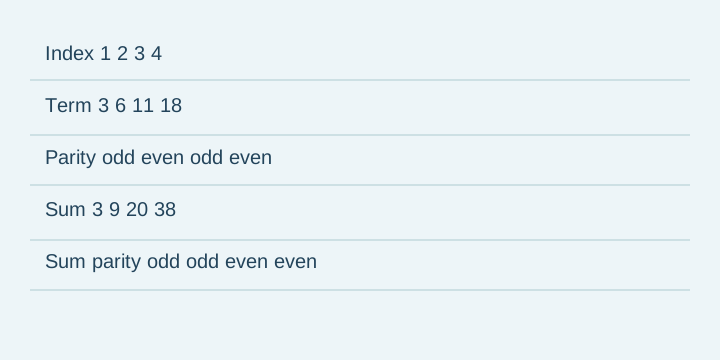
Let b indexed by j equal j squared plus two, with j a positive integer. If j is odd, its square is odd and adding two leaves it odd. If j is even, its square and the resulting term are even. Thus the terms alternate odd, even, odd, even. This conclusion does not come merely from noticing a few examples; it follows from the parity of a square. The first four values, three, six, eleven and eighteen, provide a quick consistency check rather than the entire proof.
Do not confuse terms with partial sums
Now let S indexed by n be the sum of the first n terms. The first term contributes odd parity, the next even term leaves the running sum odd, the third odd term changes it to even, and the fourth even term leaves it even. The partial sums therefore repeat odd, odd, even, even. The term parity repeats every two positions, while the partial-sum parity repeats every four. This is exactly why a table needs separate columns for index, term parity and running-sum parity.
Prove the cycle through blocks
Each block of four terms contains two odd terms and two even terms. Its sum is even, so adding a complete block does not change the current parity. After any complete collection of four-term blocks, the leftover one, two or three terms determine the final result. Therefore S indexed by n is odd when n leaves remainder one or two on division by four, and even when it leaves remainder zero or three. No formula for the sum of squares is needed to answer this particular property question.
Use the cycle on a large index
For n=2026, the remainder after division by four is two, so the partial sum is odd. For n=2027, the remainder is three, so the partial sum is even. Notice that the individual 2026th term is even even though the partial sum through that term is odd. The distinction is not a technicality; it is the requested output. When selecting a response, name the object whose parity you found. A correct pattern applied to the wrong object still produces an incorrect answer.
Transfer to a recurrence and test its boundary
A different sequence can be given by a first term and a recurrence instead of a direct formula. If a₁=2 and each next term equals twice the previous term plus one, the later terms are five, eleven and twenty-three. Every term after the first is odd because twice an integer plus one is odd, while the first term is even. This is a pattern with an exceptional starting point. State that exception rather than generalizing from later terms back to the whole sequence, and count transitions separately from term numbers.
PAUSE & TRYFor bⱼ=j²+2, is the sum through n=101 odd or even?Reveal explanation
Odd: 101 leaves remainder one modulo four; the partial-sum parity cycle is odd, odd, even, even.
Turn the idea into practice.
A fresh set will help you use the relationship with different numbers.
Practice this skillEvidence & editorial note
New number-properties video, with distinct selected sections reused across three original companions. Selected captions read; notation independently checked. Full audiovisual review not performed.
Caption track SHA-256: e42df45b7520af48050d768e1e24290a6c7d9cc7be551c39efb7c2ffc57c5875
Source segment references are retained in the catalog. Full captions remain in the local research archive.