
The selected captions use prime factorization to reason about integer powers and necessary divisibility. This article develops separate original examples, distinguishing a minimum construction from a universal conclusion.
What the integer condition contributes
An equation involving two unknowns can still reveal useful structure when both unknowns are integers. The restriction prevents arbitrary fractional choices. Instead of trying immediately to isolate one unknown, ask what prime factors must appear on both sides. If one side is a perfect square, every prime exponent on that side is even. If it is a perfect cube, every exponent is divisible by three. These requirements can determine a least multiplier or a necessary divisor without determining the complete integer.
Build the smallest square deliberately
Find the least positive integer t for which 72t is a square. Factor seventy-two as two cubed times three squared. The exponent of two is odd, while the exponent of three is already even. Multiplying by two changes the exponents to four and two, giving 144, which is twelve squared. Multiplying by three alone would leave both exponents odd. The decision is not to increase the number by a small amount; it is to repair precisely the exponents that violate the square condition.
Contrast a cube with the same starting number
Now require 72t to be a perfect cube. The exponent three on prime two already meets the requirement, but the exponent two on prime three needs one additional factor of three. The least multiplier is therefore three, giving 216, which is six cubed. The square version needed a factor two, whereas the cube version needs a factor three. The original number did not change. The target power changed which exponent deficits had to be filled, so reusing the previous multiplier would be unjustified.
Distinguish smallest from necessary
Suppose 72t is a square for a positive integer t. The prime factorization of t must have an odd exponent of two, an even exponent of three, and even exponents of all other primes. Thus t has the form two times an integer square. Every allowed t is even, but it need not equal two. Values two, eight and eighteen all work. Testing only the smallest example can suggest a necessary property, but the exponent argument explains why the property holds for every allowed value.
Read a divisor count as independent choices
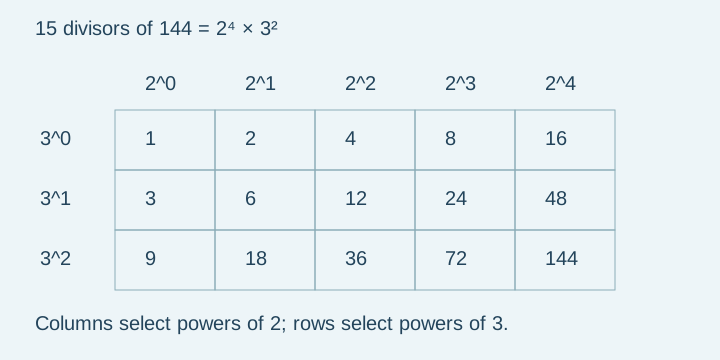
For N equal to two to the fourth times three squared, a positive divisor chooses an exponent of two from zero through four and an exponent of three from zero through two. There are five choices followed independently by three choices, giving fifteen divisors. The number four plus two equals six, but it counts prime factors with multiplicity, not divisor combinations. The diagram places the allowed exponent choices in a grid so that each cell corresponds to one unique divisor, including one at the zero-zero corner.
Use a shared prime inventory for common multiples
Compare twenty-four and thirty-six. Their factorizations are two cubed times three, and two squared times three squared. A common multiple must have at least three factors of two and two factors of three, so their least common multiple is seventy-two. The greatest common divisor instead uses the smaller exponents and equals twelve. These operations answer opposite inventory questions: enough factors to accommodate both inputs, or factors guaranteed to be present in both inputs. Naming the question prevents swapping the two formulas.
Check a candidate through the original condition
A proposed multiplier should be tested in the original expression. For example, to make fifty-four a cube, write fifty-four as two times three cubed. Two additional factors of two are needed, so the least multiplier is four. The product is 216, or six cubed. A candidate of two would give 108, whose prime-two exponent is two rather than a multiple of three. This direct check is short and catches a plausible error that merely notices an odd exponent and applies a square rule to a cube problem.
Transfer the representation without overgeneralizing
The method applies to positive integers and prime factorizations. It does not mean that every algebra problem should be converted to a factor list, or that an approximate decimal power can establish a precise integer property. On a calculator-free quantitative question, keep the prime powers symbolic for as long as possible, then multiply only if the requested answer requires a numerical value. End by separating what you found: one working example, the smallest permitted value, or a condition that every permitted value must satisfy. Each requires a different final justification.
PAUSE & TRYWhat is the least positive multiplier making 48 a perfect cube?Reveal explanation
36: 48=2⁴3, so add two powers of 2 and two powers of 3; 48×36=12³.
Turn the idea into practice.
A fresh set will help you use the relationship with different numbers.
Practice this skillEvidence & editorial note
New number-properties video, with distinct selected sections reused across three original companions. Selected captions read; notation independently checked. Full audiovisual review not performed.
Caption track SHA-256: e42df45b7520af48050d768e1e24290a6c7d9cc7be551c39efb7c2ffc57c5875
Source segment references are retained in the catalog. Full captions remain in the local research archive.