TRY A QUESTION. FOLLOW THE REASONING. Sample questions with answers Work out your answer first, then compare the explanation. This stable selection uses distinct task families across the available learning domains.
QUESTION 01 Number & proportional reasoning
Numbers that stay in balance A repair uses 2/6 meter of wire and another 3/4 meter. What total length, in meters, is used?
13/12 1/2 1/4 1/3 13/12 Both measurements use meters, so add the fractions. Use twelfths: 4/12 + 9/12. The requested value is 13/12. Check its units and meaning against the original question. Compare the other answer choices 1/2 Add numerators and denominators separately instead of using equal-sized parts.
1/3 Count only the first length of wire.
1/4 Multiply the lengths instead of adding them.
Reference basis: GED Mathematical Reasoning overview ; Siyavula Grade 10 mathematics foundation reference . These are original learning questions, not questions reproduced from the references.
QUESTION 02 Algebraic reasoning
Translate a situation before calculating A workshop estimates supply cost with C = 4n + 3m. If n = 6 and m = 9, what is C?
Write a numeric answer.
51 Replace n and m with their stated values. Calculate each product before combining the costs. The requested value is 51. Check its units and meaning against the original question. Reference basis: GED Mathematical Reasoning overview ; Siyavula Grade 10 mathematics foundation reference . These are original learning questions, not questions reproduced from the references.
QUESTION 03 Functions & modeling
Read a relationship in a table or rule A service follows a linear cost rule. It charges $24 for 2 visits and $36 for 5 visits. What is the fixed charge at zero visits?
4 24 16 8 16 The charge increases by $12 over three visits, or $4 per visit. Move back two visits from the first observation to reach zero visits. The requested value is 16. Check its units and meaning against the original question. Compare the other answer choices 4 Report the rate per visit rather than the fixed charge.
8 Report the variable cost of the first two visits.
24 Treat the first observed total as the intercept.
Reference basis: GED Mathematical Reasoning overview ; Siyavula Grade 10 mathematics foundation reference . These are original learning questions, not questions reproduced from the references.
QUESTION 04 Measurement & data
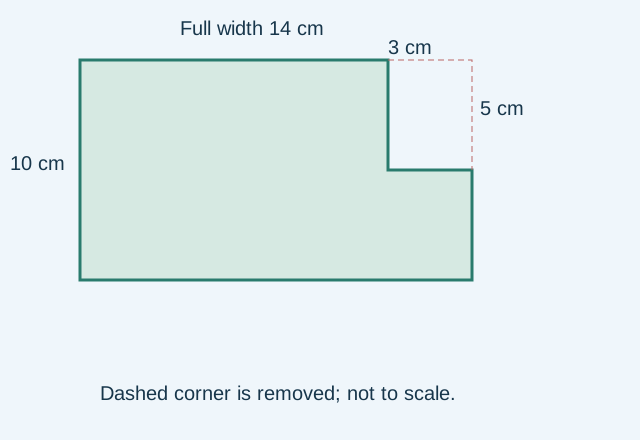
Measure shapes by breaking them apart The full sheet is 14 cm wide. Using the other dimensions in the diagram, what area remains after the dashed corner is removed, in square centimeters?
Open full-size diagram ↗ Write a numeric answer.
125 Calculate the area of the full rectangular sheet. Subtract the cut-out rectangle rather than subtracting one side length. The requested value is 125. Check its units and meaning against the original question. Reference basis: GED Mathematical Reasoning overview ; Siyavula Grade 10 mathematics foundation reference . These are original learning questions, not questions reproduced from the references.
QUESTION 05 Number & proportional reasoning
Rates, recipes and unit labels A pack of 5 replacement filters costs $15. At the same unit price, what do 8 filters cost in dollars?
18 8/3 24 15 24 Divide pack cost by its filter count to find dollars per filter. Multiply the unit price by the new number of filters. The requested value is 24. Check its units and meaning against the original question. Compare the other answer choices 15 Use the original pack cost without scaling.
18 Add the change in filter count as dollars.
8/3 Invert the unit price to one-third dollar per filter.
Reference basis: GED Mathematical Reasoning overview ; Siyavula Grade 10 mathematics foundation reference . These are original learning questions, not questions reproduced from the references.
QUESTION 06 Algebraic reasoning
Find the unknown in a practical equation A repair bill is $67, including an $18 visit fee and $7 per hour. How many hours were billed?
Write a numeric answer.
7 Subtract the fixed visit fee from the total. Divide the remaining labor charge by dollars per hour. The requested value is 7. Check its units and meaning against the original question. Reference basis: GED Mathematical Reasoning overview ; Siyavula Grade 10 mathematics foundation reference . These are original learning questions, not questions reproduced from the references.
QUESTION 07 Functions & modeling
Two conditions, one shared solution A show sells 12 tickets: adult tickets at $8 and child tickets at $5. Revenue is $75. How many adult tickets were sold?
9 5 12 7 5 If every ticket cost $5, calculate the baseline revenue. Each adult ticket adds $3 above that baseline; divide the extra revenue by 3. The requested value is 5. Check its units and meaning against the original question. Compare the other answer choices 7 Report child tickets instead of adult tickets.
9 Divide total revenue by adult price as though all tickets cost the same, taking whole tickets.
12 Assume every ticket is an adult ticket.
Reference basis: GED Mathematical Reasoning overview ; Siyavula Grade 10 mathematics foundation reference . These are original learning questions, not questions reproduced from the references.
QUESTION 08 Measurement & data
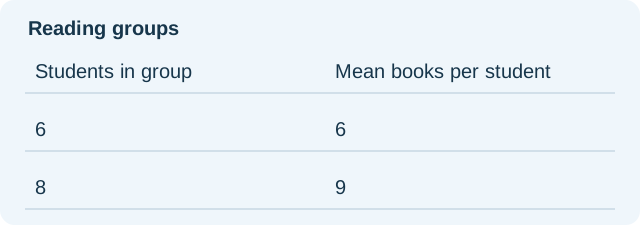
Summaries that answer the actual question The first reading group has 6 students. Use both groups in the table to find the mean number of books per student across all students.
Open full-size diagram ↗ Write a numeric answer.
54/7 Recover each group total by multiplying its mean by its size. Add the totals and divide by the combined number of students. The requested value is 54/7. Check its units and meaning against the original question. Reference basis: GED Mathematical Reasoning overview ; Siyavula Grade 10 mathematics foundation reference . These are original learning questions, not questions reproduced from the references.
QUESTION 09 Number & proportional reasoning
Budgets, discounts and percent change A tool priced at $100 is discounted by 15%. What is the sale price before tax, in dollars?
15 17/20 85 115 85 A 15% discount leaves 85% of the original price. Apply the multiplier to the original price, not to the discount amount. The requested value is 85. Check its units and meaning against the original question. Compare the other answer choices 15 Report the discount amount instead of the amount paid.
115 Apply a markup instead of a discount.
17/20 Convert the percent to a decimal twice.
Reference basis: GED Mathematical Reasoning overview ; Siyavula Grade 10 mathematics foundation reference . These are original learning questions, not questions reproduced from the references.
QUESTION 10 Algebraic reasoning
Budgets and whole-number constraints With a $86 budget, a club pays a $12 setup fee and $9 per badge. What is the greatest whole number of badges it can buy?
Write a numeric answer.
8 Subtract the fixed setup fee before allocating money to badges. The whole-number maximum is the floor of the remaining budget divided by 9. The requested value is 8. Check its units and meaning against the original question. Reference basis: GED Mathematical Reasoning overview ; Siyavula Grade 10 mathematics foundation reference . These are original learning questions, not questions reproduced from the references.