
The decision and its conditions
A function permits one output for each input, although several inputs may share an output. Repeated input rows therefore need careful inspection. Comparing two models requires comparing the same feature, such as a rate, and keeping units consistent. Piecewise rules are still functions when exactly one branch applies at each allowed input. A finite domain may contain negative and positive inputs that produce the same squared output, so the number of outputs can be smaller than the number of inputs. Read conditions and definitions before applying routine substitution.
Worked example
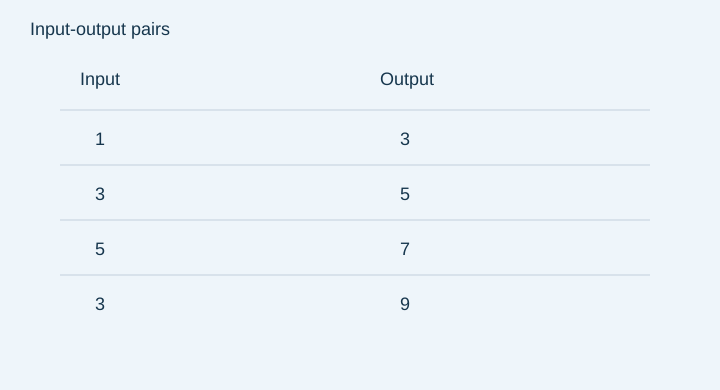
Given figure data: Input-output pairs. Columns Input, Output. Rows: (1, 3), (3, 5), (5, 7), (3, 9). The table is a relation recorded on day 1. Which input prevents it from being a function? A function must assign only one output to each input. Input 3 is paired with outputs 5 and 9. That conflicting input is 3; repeated outputs for different inputs would be allowed.
A contrasting decision
Tank A fills according to A(t)=3t+7 liters. Tank B gains 12 liters every 2 minutes. What is the ratio of B’s filling rate to A’s? A has rate 3 liters per minute; its initial seven liters do not affect the rate. B has rate 12/2=6 liters per minute. The requested ratio B/A is 2.
Diagnose a competing method
The first example’s tempting answer 1 follows this mistake: Choose an input that has only one listed output. Look for one input paired with different outputs, not repeated output values.
Transfer before revealing
A fee is f(x)=3x for x<5, and f(x)=2x+5 for x≥5. What is f(5)? Pause and identify the requested quantity. Solution: The input equals 5, so it belongs to the inclusive second branch. Use 2×5+5, not the first rule. The fee is 15 dollars.
Check the boundary of the method
A finite domain may contain negative and positive inputs that produce the same squared output, so the number of outputs can be smaller than the number of inputs. Convert both representations to rates in the same units before forming the requested ratio. Compare the answer with the question’s units and conditions. One correct example does not prove an identity or a statistical generalization.
The table is a relation recorded on day 1. Which input prevents it from being a function?
 Open full-size diagram ↗
- A function must assign only one output to each input.
- Input 3 is paired with outputs 5 and 9.
- That conflicting input is 3; repeated outputs for different inputs would be allowed.
Compare the other answer choices
Choose an input that has only one listed output.
Choose another input that has only one listed output.
Report an output instead of the repeated input.
Try it, then explain it.
Complete a short set without looking at the example. After each answer, explain which operation preserved the relationship and why the result makes sense.
Sources & authorship
Original Slope explanations and examples. References support the concepts; they are not the source of copied questions. Independent educator review is pending.
GED Mathematical Reasoning Assessment Guide for Educators