
The source explains foundational coordinate, slope and intercept relationships. This companion applies those ideas to independently authored GED-style learning examples; it does not reproduce the source test questions.
A useful model starts with labels
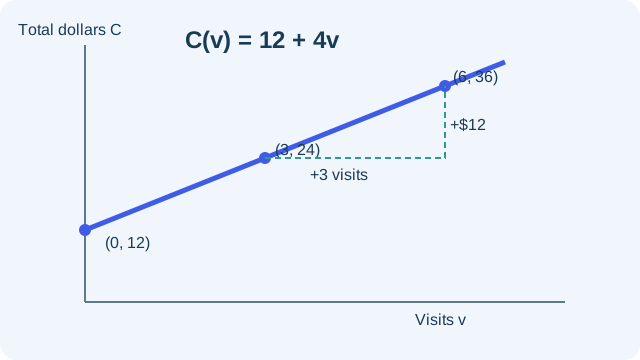
A household service has two kinds of charges: a fixed booking charge and an amount for each visit. Before reaching for a formula, define the input as the number of visits and the output as total dollars. That decision fixes the meaning of every coordinate. The point (3, 24) says that three visits cost twenty-four dollars; it does not say that twenty-four visits cost three dollars.
This companion uses a new service example to practice foundational skills relevant to GED Mathematical Reasoning. The linked video was produced for SAT preparation, but the underlying slope and intercept concepts are shared. Its source map identifies those concepts only. Our money amounts, diagrams, explanations and checks are independently written, and the video does not establish current GED rules.
Separate the starting charge from the rate
Suppose three visits cost $24 and six visits cost $36. The total increases by twelve dollars when the visit count increases by three. Divide those changes to obtain four dollars per visit. Notice that neither 24 divided by 3 nor 36 divided by 6 gives the correct marginal rate: each total also includes the fixed charge.
Now return to the first observation. Three visits account for twelve dollars of variable charges, so the remaining twelve dollars must be the booking charge. The model is C(v) = 12 + 4v. Its intercept is not an extra visit. It is the amount the rule assigns when the input is zero, before any per-visit charges are added.
PAUSE & TRYWhat total does the model predict for five visits?Reveal explanation
$32, because 12 + 4 × 5 = 32.
Use the graph to check the arithmetic
The graph begins at an output of twelve on the vertical axis. Moving one visit to the right raises the total by four dollars. The two observed points belong to that same straight line, so they provide a second way to check the model. If a plotted point misses the line, recheck the scale, the coordinates and the equation rather than immediately changing the formula.
In this context, whole numbers of visits may be the only meaningful inputs. The drawn line shows the mathematical relationship continuously, but it does not require a customer to purchase half a visit. A graph and a context must be interpreted together. Similarly, extending the line to negative visits produces mathematical coordinates without a sensible booking interpretation.
Work backward from a budget
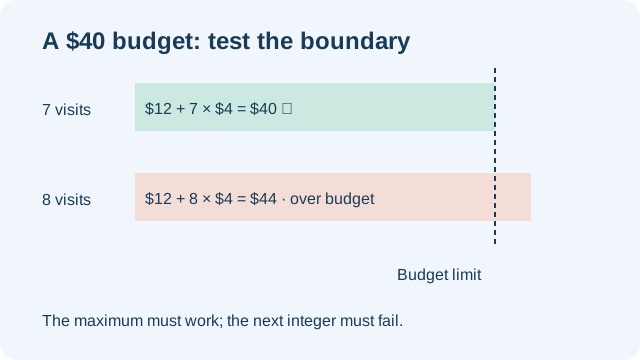
A customer has a forty-dollar budget. To find the largest allowed number of visits, begin with 12 + 4v ≤ 40. Subtract twelve from both sides to obtain 4v ≤ 28, then divide by four to find v ≤ 7. Seven visits cost exactly forty dollars. Eight visits would cost forty-four dollars and fail the original budget condition.
This check is stronger than merely saying that seven feels reasonable. It verifies the proposed maximum and the next excluded whole number. If the budget were thirty-eight dollars, the inequality would allow v ≤ 6.5, but a whole-visit restriction would reduce the purchase maximum to six. Rounding to the nearest integer would incorrectly suggest seven.
PAUSE & TRYWith a $34 budget, what is the maximum whole number of visits?Reveal explanation
5 visits. Six would cost $36, which exceeds the budget.
Choose the right question for the model
Some questions ask for a total, some ask for an input, and others ask what a coefficient means. For a total, substitute the visit count. For an input, set the output equal to the given amount and solve. For an interpretation, keep the units attached: the coefficient four is dollars per visit, while twelve is dollars paid independently of the visit count.
A common distractor reports the rate when the question asks for the starting charge. Another uses the first observed total as the intercept. Read the final sentence before calculating. Then write one brief sentence explaining your answer in context. That habit makes an otherwise mechanical calculation useful when the same structure appears in wages, delivery charges or a phone plan.
A short transfer check
Try a second model without copying the earlier numbers. A rental company charges $9 to start and $6 for each hour. After four hours the total is $33. If a receipt shows $45, subtract the nine-dollar fixed charge before dividing by six; the rental lasted six hours. Dividing the full receipt by six would mix the fixed and variable parts.
Finally, distinguish a model from a promise about real pricing. A real company may round time, add taxes or change its rate after a threshold. Use the conditions stated in a mathematics problem, and avoid importing unmentioned fees. When reading an actual bill, check those conditions rather than assuming every charge follows one straight line.
Turn the idea into practice.
A fresh set will help you use the relationship with different numbers.
Practice this skillEvidence & editorial note
Existing caption evidence is explicitly reused from the SAT foundation archive. The full caption track was read; full audiovisual review was not performed. Video exam branding is SAT, while this original companion teaches shared mathematics in a GED learning context. Caption notation is checked independently.
Original instructional companion and SVG illustrations; brief source synopsis and timestamp index.
Caption track SHA-256: 950946b8f5c3b339f834de1c5cb2510c365a313ba18bcb0e1aae568aae2f77b2
Source segment references are retained in the catalog. Full captions remain in the local research archive.