
The source demonstrates conversion between standard and scientific notation, then ratio, difference and product contexts.
Keep the value while changing its representation
Scientific notation writes a positive quantity as a coefficient from one up to, but not including, ten, multiplied by a power of ten. The purpose is to make scale visible while preserving the quantity. For example, 52,000 becomes 5.2 × 10⁴. Nothing about the measured amount changes. This companion follows the conversion and operation decisions in the linked Get Sum Math lesson, using independently written examples. Its captions were read throughout; the full audiovisual presentation has not been reviewed. The examples here are practice quantities, not claims about current populations, physical objects or examination policies.
Use the exponent to check direction
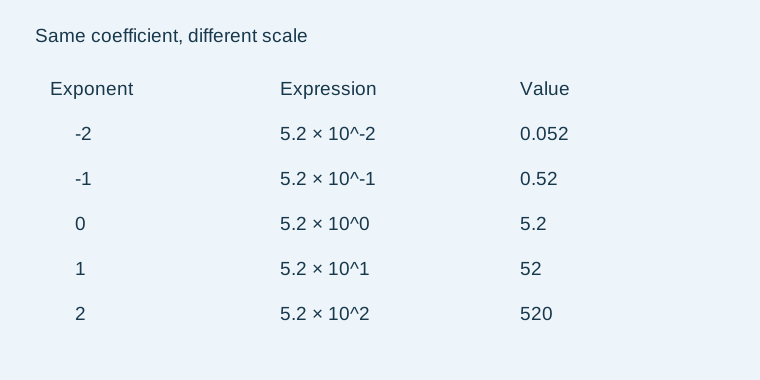
The value 5.2 × 10⁴ is greater than five because multiplication by ten thousand enlarges it. By contrast, 5.2 × 10⁻⁴ is 0.00052. A negative exponent does not make the quantity negative: it makes the power of ten a reciprocal. Write 10⁻⁴ as 1/10,000 when the decimal movement feels uncertain. The place-value table shows the same coefficient at different scales. Moving from exponent −2 to exponent −1 multiplies the value by ten; moving the other way divides by ten. This is a multiplicative pattern, not an additive sequence.
Normalize the coefficient after arithmetic
Consider (4 × 10³)(6 × 10⁻²). The coefficient product is twenty-four, and the exponent sum is one, giving 24 × 10¹. That value is 240, but its coefficient is not yet in normalized scientific notation. Replace twenty-four by 2.4 × 10, then combine the powers to obtain 2.4 × 10². Check by expanding both original factors: 4,000 × 0.06 = 240. Adding one to the exponent is justified by moving one factor of ten from the coefficient, not by a rule that every multiplication automatically increases the exponent.
Distinguish a ratio from an amount of excess
Two hypothetical containers hold 8.4 × 10⁵ and 2.1 × 10⁴ grains. Asking how many times as many grains the first holds requires a ratio. Divide the coefficients, 8.4/2.1 = 4, and subtract the exponents, 5−4 = 1. The result is forty, a dimensionless comparison. Asking how many more grains requires subtraction instead: 840,000−21,000 = 819,000 grains. The answers forty and 819,000 are not competing numerical estimates. They answer different questions with different units. Read the comparison language before entering either calculation.
Handle a source wording problem explicitly
At approximately 6:05, the linked video says how much heavier but computes a ratio, and the publisher’s video description identifies that wording as a correction. This article uses the precise phrase how many times as massive for division and mass difference for subtraction. The mathematical choice must follow the intended quantity rather than a memorized habit of putting a larger number above a smaller one. A ratio can be less than one when the question requests the smaller quantity relative to the larger. Reversing a requested ratio changes the comparison even if the calculator arithmetic is correct.
Build a product from its units
A model layer is 2.5 × 10⁻³ millimeters thick and a stack contains 1.2 × 10⁴ identical layers. Multiply thickness per layer by number of layers: the layer units cancel, leaving millimeters. The coefficient product is three and the exponent sum is one, so the total thickness is thirty millimeters. This assumes the layers have the specified uniform thickness and no gaps; it is an idealized model. A drawing of only a few representative layers does not assert that the stack contains only those pictured layers. Its function is to show why multiplication is appropriate.
Subtract quantities at a common scale
To compute 7.6 × 10⁴ − 2.3 × 10³, rewrite the second term as 0.23 × 10⁴. Then subtract coefficients: (7.6−0.23) × 10⁴ = 7.37 × 10⁴. Subtracting the exponents would apply a division rule to a subtraction problem and produce a different quantity. Expanding to 76,000−2,300 = 73,700 is an equally valid check. When a calculator displays an exponent field, leave that field before typing a new operation; otherwise the expression being evaluated may differ from the one on paper. The exact button sequence depends on the device.
Transfer and justify
Try a sample that is 3 × 10⁻⁵ meters wide repeated 2 × 10⁶ times. A product model gives six times ten to the first power, or sixty meters. The negative exponent in one factor does not force a small final answer because the number of repetitions is large. Before accepting the result, explain the operation in ordinary language, check whether the coefficient is normalized, and restore the requested unit. These checks catch different errors: a correct exponent cannot rescue a wrong operation, and a correct numerical value may still be reported in an unintended representation.
PAUSE & TRYA sheet is 4 × 10⁻³ meters thick. What is the thickness of 3 × 10² identical sheets with no gaps?Reveal explanation
1.2 meters: (4×3)×10^(−3+2)=12×10⁻¹=1.2.
Turn the idea into practice.
A fresh set will help you use the relationship with different numbers.
Practice this skillEvidence & editorial note
New public English caption acquisition; complete retained track read. Original examples and figures; no source questions or media republished. The ratio wording at 6:05 is explicitly corrected in this companion.
Original instructional companion with explicit source boundaries.
Caption track SHA-256: 65361c5196598c33884fa92b38f342aeb38a8d9d8df0bd8ede7c79e13c263967
Source segment references are retained in the catalog. Full captions remain in the local research archive.