
The inspected captions explain inverse trigonometric functions, principal ranges and unit-circle reasoning. Original examples below apply the distinction between an inverse value and all solutions of an equation.
Start with the direction of the question
Sine takes an angle and returns a unit-circle height. Inverse sine reverses that direction: it receives a height and returns an angle. Those two inputs have different meanings and different units. In an original example, sin30°=1/2, while arcsin(1/2)=30°. The first answer is a dimensionless ratio; the second is an angle. Writing an inverse-sine answer as one half would answer the original sine question again. Before calculating, describe aloud which quantity you know and which one you are trying to recover. This small translation prevents an otherwise invisible change of task.
One height, several possible angles
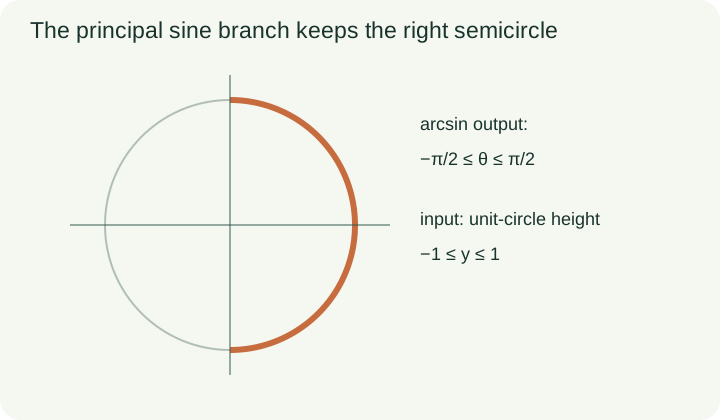
A horizontal line at height one half intersects the unit circle at angles30° and150°. Adding any complete turn produces still more angles with the same sine. An unrestricted reverse relation therefore has many outputs for one input. A function needs a single output, so inverse sine uses the angle interval from−90° to90°, including both endpoints. The right half of the circle covers every permitted height exactly once. In our example,30° lies inside that interval and150° does not. Both solve a sine equation, but only30° is the principal inverse-sine value. The restriction is part of the definition, not a calculator preference.
PAUSE & TRYEvaluate arcsin(sin150°) in degrees.Reveal explanation
30°, because the principal arcsin range is−90°to90°.
Work a composition in the correct order
Consider arcsin(sin150°). First evaluate the inner sine: its value is1/2 because150° and30° have equal unit-circle heights. Then apply inverse sine to1/2, obtaining30°. Simply canceling the words arcsin and sin would produce150°, outside the allowed output interval. For a negative example, sin210°=−1/2 and arcsin(−1/2)=−30°. A negative height corresponds to the lower half of the permitted right semicircle. The original angle210° is not recovered because the sine value discarded information about which turn and which symmetric point produced it.
Separate inverse notation from reciprocals
The notation sin⁻¹(x) often means inverse sine, while(sin x)⁻¹ means the reciprocal of a sine value. Parentheses and context matter. For x=1/2, inverse sine returns30° in degree mode. The reciprocal of1/2 is2, a number that is not even a possible sine output. The reciprocal trigonometric function has its own name, cosecant. In a written solution, use arcsin when the superscript notation might confuse the reader. Explain that you are recovering an angle, not dividing one by a ratio. This distinction also helps when checking the units of an applied model.
Check both domains and units
Real inverse sine accepts inputs only between−1 and1. A request such as arcsin(1.2) has no real answer because no point on the unit circle has height1.2. Do not repair that problem by changing a calculator mode. Mode changes affect how an angle is displayed; they do not broaden the real domain. A result ofπ/6 radians and a result of30° represent the same angle. If you report a decimal, label its angle unit and keep enough precision for subsequent calculations. An inverse function can be mathematically defined even when a real-world model imposes a narrower admissible input range.
Transfer to solving an equation
Solve sin(2x)=1/2 on0≤x<180°. The inner angle2x runs through0≤2x<360°. Its two solutions are30° and150°, so x=15° or75°. Calling arcsin(1/2) gives the first inner angle, but the second branch still needs unit-circle reasoning. This exercise shows why inverse evaluation and equation solving should not be treated as interchangeable tasks. For self-assessment, explain the range restriction, show both inner-angle branches, and verify both final x-values by substitution. An original extension asks for arcsin(sin300°); its answer is−60°, since the principal representative shares the negative height. These examples are original teaching applications of the source’s captioned explanation, not a reproduction of a question bank.
PAUSE & TRYSolve sin(2x)=1/2 for0≤x<180°.Reveal explanation
x=15°or75°; both sine branches lie in the transformed inner-angle interval.
What the video evidence supports
The inspected captions explain inverse sine as recovering an angle, motivate restricting its output, and work with a negative unit-circle height. Automatic captions occasionally confuse mathematical symbols, so the equations in this companion were independently checked. The diagram and practice examples are original. Selected caption text was read; full audiovisual review and educator review remain pending. Use the timestamp links to compare the core definition with the source explanation, then use the transfer task to test whether you can apply that definition beyond the example shown.
Turn the idea into practice.
A fresh set will help you use the relationship with different numbers.
Practice this skillEvidence & editorial note
Selected actual caption text read; original examples and figures checked. Newly acquired caption source. Full audiovisual and educator review pending.
Original teaching companion with brief source synopsis; not a transcript reproduction.
Caption track SHA-256: efe02ecd403d45362d29806a968f64f37c336827cdc3ef150c43e5810877a388
Source segment references are retained in the catalog. Full captions remain in the local research archive.