
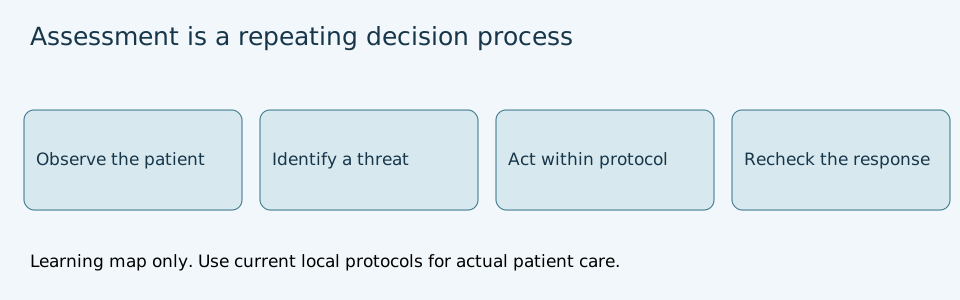
Original worked contrasts connect a stated finding to the assessment category or decision it supports. This is independent teaching, not a video summary or an official examination item.
The decision to practise
A useful EMT assessment starts by identifying which decision is actually being asked. A true statement can still be the wrong choice when it belongs to a different stage or describes a different observation. This guide uses original contrasts to separate those nearby ideas. Read the case, name the decisive finding, and explain why an attractive alternative answers another question. The purpose is not to memorize a numbered field algorithm. Actual care follows current local protocols, authorized training, and medical direction.
For each example, distinguish three layers: the observations or reported history, the provisional interpretation, and the action or information need that follows. Keep an uncertain layer uncertain. This makes it easier to update the plan when new information arrives instead of defending an early label. A change in the patient or environment can invalidate an earlier safe or stable impression.
Classify responsiveness on AVPU
The key distinctions are these. Alert means spontaneously awake and appropriately responsive in the assessed context. Response to voice requires a verbal stimulus rather than spontaneous alertness. A response only to an appropriately applied noxious stimulus is distinct from response to voice. No response to the assessed verbal and appropriate pain stimulus is unresponsive.
A patient is spontaneously awake, makes eye contact, and answers questions appropriately. Which AVPU category fits? Work the case in order. No stimulus is needed to obtain a meaningful response. Therefore the matching choice is Alert. Compare that with Responds to verbal stimulus: Response to voice requires a verbal stimulus rather than spontaneous alertness. That alternative may be important in another situation, but it is not the concept selected by the stated details here. The useful check is whether the choice answers this case rather than whether it is generally related to EMS.
A patient keeps the eyes closed until you call their name, then opens them. Which AVPU category fits the observed response? Work the case in order. Voice produces the response. Therefore the matching choice is Responds to verbal stimulus. Compare that with Responds to pain stimulus: A response only to an appropriately applied noxious stimulus is distinct from response to voice. That alternative may be important in another situation, but it is not the concept selected by the stated details here. The useful check is whether the choice answers this case rather than whether it is generally related to EMS.
A patient does not react to voice but withdraws from an appropriate pain stimulus. Which AVPU category fits? Work the case in order. The response occurs only with the noxious stimulus. Therefore the matching choice is Responds to pain stimulus. Compare that with Unresponsive: No response to the assessed verbal and appropriate pain stimulus is unresponsive. That alternative may be important in another situation, but it is not the concept selected by the stated details here. The useful check is whether the choice answers this case rather than whether it is generally related to EMS.
A patient has no response to voice or an appropriate pain stimulus. Which AVPU category fits? Work the case in order. Neither assessed stimulus produced a response. Therefore the matching choice is Unresponsive. Compare that with Alert: Alert means spontaneously awake and appropriately responsive in the assessed context. That alternative may be important in another situation, but it is not the concept selected by the stated details here. The useful check is whether the choice answers this case rather than whether it is generally related to EMS.
PAUSE & TRYA patient is spontaneously awake, makes eye contact, and answers questions appropriately. Which AVPU category fits?Reveal explanation
Alert. No stimulus is needed to obtain a meaningful response.
Separate breathing concepts
The key distinctions are these. Ventilation concerns moving gas into and out of the respiratory system. Oxygenation concerns oxygen transfer and oxygen carried in blood. Perfusion concerns delivery by circulating blood. Respiratory rate is a frequency measure and not a complete measure of ventilation.
A teaching case asks whether enough air is moving with each assisted breath. Which concept is central? Work the case in order. The case asks about movement of air. Therefore the matching choice is Ventilation: movement of air. Compare that with Oxygenation: oxygen loading or delivery to blood: Oxygenation concerns oxygen transfer and oxygen carried in blood. That alternative may be important in another situation, but it is not the concept selected by the stated details here. The useful check is whether the choice answers this case rather than whether it is generally related to EMS.
A teaching case asks whether oxygen is transferring into the blood. Which concept is central? Work the case in order. The issue is oxygen entering and being carried by blood. Therefore the matching choice is Oxygenation: oxygen loading or delivery to blood. Compare that with Perfusion: blood flow to tissues: Perfusion concerns delivery by circulating blood. That alternative may be important in another situation, but it is not the concept selected by the stated details here. The useful check is whether the choice answers this case rather than whether it is generally related to EMS.
A teaching case asks whether blood flow is reaching body tissues. Which concept is central? Work the case in order. The issue is circulation to tissues. Therefore the matching choice is Perfusion: blood flow to tissues. Compare that with Respiratory rate: breaths counted over time: Respiratory rate is a frequency measure and not a complete measure of ventilation. That alternative may be important in another situation, but it is not the concept selected by the stated details here. The useful check is whether the choice answers this case rather than whether it is generally related to EMS.
A learner records 18 breaths in one minute without describing depth. Which variable has been measured? Work the case in order. Counting the breaths gives their rate, not the entire adequacy of breathing. Therefore the matching choice is Respiratory rate: breaths counted over time. Compare that with Ventilation: movement of air: Ventilation concerns moving gas into and out of the respiratory system. That alternative may be important in another situation, but it is not the concept selected by the stated details here. The useful check is whether the choice answers this case rather than whether it is generally related to EMS.
PAUSE & TRYA teaching case asks whether enough air is moving with each assisted breath. Which concept is central?Reveal explanation
Ventilation: movement of air. The case asks about movement of air.
Interpret perfusion using the whole picture
The key distinctions are these. A cluster of abnormal findings can be more informative than a single isolated value. Compensation or an early stage can leave one measurement apparently normal. Trends help reveal a changing condition. Signs inform a working impression but do not independently prove one disease.
A patient has worsening responsiveness, weak pulses, and heavy bleeding. How should the cluster be interpreted? Work the case in order. Multiple linked circulation concerns support urgency. Therefore the matching choice is Several concerning findings strengthen the need for prompt assessment. Compare that with One normal measurement does not exclude an evolving problem: Compensation or an early stage can leave one measurement apparently normal. That alternative may be important in another situation, but it is not the concept selected by the stated details here. The useful check is whether the choice answers this case rather than whether it is generally related to EMS.
A patient has major blood loss, but the first blood pressure is within a familiar range. What caution applies? Work the case in order. One blood pressure value does not cancel the blood-loss history and other findings. Therefore the matching choice is One normal measurement does not exclude an evolving problem. Compare that with A change from baseline deserves reassessment: Trends help reveal a changing condition. That alternative may be important in another situation, but it is not the concept selected by the stated details here. The useful check is whether the choice answers this case rather than whether it is generally related to EMS.
A previously strong pulse becomes weaker during transport. What does this change require? Work the case in order. A deterioration in an assessed finding requires another primary assessment. Therefore the matching choice is A change from baseline deserves reassessment. Compare that with An isolated appearance finding is not a final diagnosis: Signs inform a working impression but do not independently prove one disease. That alternative may be important in another situation, but it is not the concept selected by the stated details here. The useful check is whether the choice answers this case rather than whether it is generally related to EMS.
An EMT sees pale skin and immediately labels one specific disease as proven. What is the reasoning error? Work the case in order. Pallor can have multiple causes and needs supporting assessment. Therefore the matching choice is An isolated appearance finding is not a final diagnosis. Compare that with Several concerning findings strengthen the need for prompt assessment: A cluster of abnormal findings can be more informative than a single isolated value. That alternative may be important in another situation, but it is not the concept selected by the stated details here. The useful check is whether the choice answers this case rather than whether it is generally related to EMS.
PAUSE & TRYA patient has worsening responsiveness, weak pulses, and heavy bleeding. How should the cluster be interpreted?Reveal explanation
Several concerning findings strengthen the need for prompt assessment. Multiple linked circulation concerns support urgency.
Transfer without overclaiming
Now change one important condition in an example: replace the environmental hazard, change the observed responsiveness, or remove the source of a reported history. Explain which conclusion must change and which remains supported. This is a stronger self-check than recalling the answer position. It tests whether the rule was connected to the evidence. If an answer depends on a fact not supplied or a local protocol not available, state the missing information instead of inventing it.
Before moving to a practice set, say what this guide does not establish. It does not confirm a final diagnosis, authorize a new procedure, replace an EMT education program, or predict a certification result. Its examples teach assessment vocabulary and boundaries. Use qualified instruction and current local clinical resources for treatment decisions, and use the official National Registry materials for current examination administration.
Turn the idea into practice.
Apply the rule to a new case, then explain your choice.
Practice this skillSources & authorship
Original examples informed by the current official task plan and foundational instructional references. No source question text or video transcript is reproduced.
Original Slope teaching and case contrasts.
Independent educator review is pending. This guide is not an official exam paper or a video transcript.
National Registry EMT Examination Specifications, Spring 2025 onwardNational EMS Education Standards EMT Instructional Guidelines