
Use original case comparisons to connect relevant cues, justified nursing actions and reassessment. This is foundation teaching, not an official examination simulation.
Build a reasoned response from the cue
A foundation question usually gives less information than a full clinical encounter. That limitation is a reason to read the supplied findings carefully, not a reason to invent the missing assessment. Begin by naming the cue that changes the decision: a new symptom, a contradiction, an inability to understand an instruction, a contamination event or an unresolved result. Ask what can be concluded now and what still needs the appropriate clinician or process. A familiar task can become a different problem when its circumstances change.
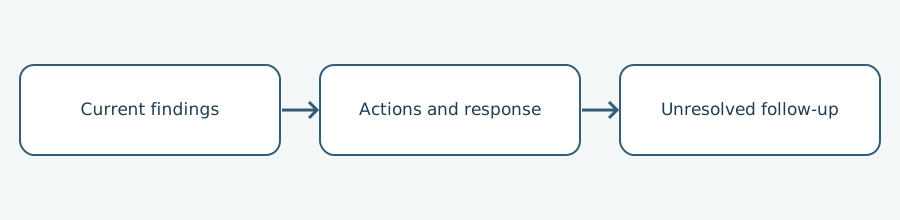
The original diagram separates three stages that are easily blurred in a memorized answer. Recognition identifies the relevant observation. Action uses the verified plan and the clinician's professional role. Evaluation asks whether the intended response actually occurred. Completing a task, administering an intervention or passing responsibility to another team member does not itself establish a safe outcome. The following original case comparisons make those distinctions explicit without pretending to reproduce an official NCLEX case study.
Delegation for a stable client
A trained assistive worker can collect routine intake data for a stable client, but a new symptom has also been reported. A stable predictable task may be delegated when allowed by jurisdiction, facility policy and demonstrated competence. The RN evaluates the situation, gives clear directions and follows up; assessment and clinical decisions are not automatically transferred with the task.
The justified response is: Verify the task and worker's competence, give clear directions, and retain nursing assessment, supervision and follow-up. Compare that with the proposal to assign the task without follow-up because the trained worker accepts responsibility for reporting any serious problem. The contrast matters because the RN still provides appropriate supervision and evaluation.
PAUSE & TRYWhat uncertainty or observed cue controls this decision?Reveal explanation
Relevant cue: A trained assistive worker can collect routine intake data for a stable client, but a new symptom has also been reported. A stable predictable task may be delegated when allowed by jurisdiction, facility policy and demonstrated competence. The RN evaluates the situation, gives clear directions and follows up; assessment and clinical decisions are not automatically transferred with the task.
Informed refusal by a capable adult
A capable client asks to discuss alternatives before taking a scheduled treatment. A capable adult participates in decisions and may refuse an intervention. Clarify the concern and the person's understanding, involve the relevant clinician, document the discussion and continue appropriate care.
The justified response is: Respect the capable adult's refusal, explore understanding and alternatives, and notify the responsible prescribing clinician. Compare that with the proposal to ask a relative to choose instead because the capable adult's decision differs from the clinician's recommended treatment. The contrast matters because a relative is not automatically the decision-maker for a capable adult.
PAUSE & TRYWhat uncertainty or observed cue controls this decision?Reveal explanation
Relevant cue: A capable client asks to discuss alternatives before taking a scheduled treatment. A capable adult participates in decisions and may refuse an intervention. Clarify the concern and the person's understanding, involve the relevant clinician, document the discussion and continue appropriate care.
Authorized disclosure
An RN is invited to discuss an identifiable clinical story on social media. Protect information in conversation, electronic systems and written records. Determine whether disclosure is authorized and appropriate to the purpose rather than assuming that professional curiosity or family interest is sufficient.
The justified response is: Verify authorization and a legitimate care purpose, then disclose only appropriate identifiable information through an approved channel. Compare that with the proposal to discuss the identifiable case in a busy corridor because the other clinician also works in the hospital. The contrast matters because public discussion can disclose information to unauthorized people.
PAUSE & TRYWhat uncertainty or observed cue controls this decision?Reveal explanation
Relevant cue: An RN is invited to discuss an identifiable clinical story on social media. Protect information in conversation, electronic systems and written records. Determine whether disclosure is authorized and appropriate to the purpose rather than assuming that professional curiosity or family interest is sufficient.
Handoff of unresolved concerns
A concerning trend has been escalated, but further instructions are still pending. A safe handoff distinguishes an observed cue, an interpretation, actions and the response. Explicitly identify pending results and unresolved needs so the receiving clinician can continue the plan.
The justified response is: State the current findings, actions already taken, and unresolved concern or pending result requiring follow-up. Compare that with the proposal to describe the intervention as successful before reassessing whether the relevant finding or symptom has actually improved. The contrast matters because a completed intervention does not prove an improved outcome.
PAUSE & TRYWhat uncertainty or observed cue controls this decision?Reveal explanation
Relevant cue: A concerning trend has been escalated, but further instructions are still pending. A safe handoff distinguishes an observed cue, an interpretation, actions and the response. Explicitly identify pending results and unresolved needs so the receiving clinician can continue the plan.
Traceable record corrections
A chart entry contains a measurement that was transcribed incorrectly. Documentation records what was assessed, provided and observed. A correction should preserve record integrity rather than conceal the original entry or invent a past observation.
The justified response is: Record the actual findings and original observation time, and use the approved traceable correction or late-entry process. Compare that with the proposal to replace an unusual observed measurement with the client's typical value because the original reading appears unlikely. The contrast matters because changing an observation to appear normal falsifies the record.
PAUSE & TRYWhat uncertainty or observed cue controls this decision?Reveal explanation
Relevant cue: A chart entry contains a measurement that was transcribed incorrectly. Documentation records what was assessed, provided and observed. A correction should preserve record integrity rather than conceal the original entry or invent a past observation.
Responding to a client's concern
A client says that an important care preference has not been considered. Advocacy preserves the person's voice while using an appropriate team process. Listen, distinguish an immediate safety issue from a service concern, and document the relevant facts.
The justified response is: Clarify the concern, assess immediate needs, and support access to the appropriate care or grievance process. Compare that with the proposal to guarantee the complaint will produce the exact outcome requested before any assessment or review has taken place. The contrast matters because the RN cannot guarantee an investigation's result.
PAUSE & TRYWhat uncertainty or observed cue controls this decision?Reveal explanation
Relevant cue: A client says that an important care preference has not been considered. Advocacy preserves the person's voice while using an appropriate team process. Listen, distinguish an immediate safety issue from a service concern, and document the relevant facts.
Individualized mobility assistance
A client's current transfer plan requires help that is not yet available. Safe mobility depends on the client's current ability, equipment and required assistance. Reassess a new limitation and obtain appropriate help rather than relying on routine alone.
The justified response is: Use the current assessed assistance level and obtain the required personnel and equipment before mobilizing. Compare that with the proposal to use visibly damaged mobility equipment temporarily because replacement would delay the planned activity or transfer. The contrast matters because a known equipment hazard needs correction.
PAUSE & TRYWhat uncertainty or observed cue controls this decision?Reveal explanation
Relevant cue: A client's current transfer plan requires help that is not yet available. Safe mobility depends on the client's current ability, equipment and required assistance. Reassess a new limitation and obtain appropriate help rather than relying on routine alone.
Comfort needs and reassessment
A comfort measure has been provided and its effect is unknown. Comfort includes the person's report, relevant observations, preferences and the response to care. Evaluation closes the loop between a proposed intervention and the actual outcome.
The justified response is: Assess the reported discomfort, use the individualized plan, and reassess the response to care. Compare that with the proposal to record the problem as resolved immediately after an intervention without checking whether the intended response occurred. The contrast matters because an intervention needs follow-up evaluation.
PAUSE & TRYWhat uncertainty or observed cue controls this decision?Reveal explanation
Relevant cue: A comfort measure has been provided and its effect is unknown. Comfort includes the person's report, relevant observations, preferences and the response to care. Evaluation closes the loop between a proposed intervention and the actual outcome.
Recognizing a potentially worsening infection
A client with an infection develops new confusion. An infection accompanied by new confusion, breathing difficulty, clammy skin or circulatory changes raises concern for serious deterioration. Prompt assessment and escalation are more appropriate than waiting for a complete symptom list.
The justified response is: Assess the new change promptly and escalate concern for possible systemic infection-related deterioration. Compare that with the proposal to treat new systemic symptoms as routine because the client already has an infection documented and treatment planned. The contrast matters because an existing infection can trigger systemic illness.
PAUSE & TRYWhat uncertainty or observed cue controls this decision?Reveal explanation
Relevant cue: A client with an infection develops new confusion. An infection accompanied by new confusion, breathing difficulty, clammy skin or circulatory changes raises concern for serious deterioration. Prompt assessment and escalation are more appropriate than waiting for a complete symptom list.
Prioritizing an acute change
A stable comfort request coincides with another client's sudden stroke-like signs. Priority follows the current potential threat and required response, not routine order or earlier stability. Assess the acute change and arrange the appropriate team support while ensuring other needs are communicated.
The justified response is: Prioritize assessment of the new potentially life-threatening change and obtain the appropriate urgent team support. Compare that with the proposal to prioritize according to room number instead of the current findings and the possibility of rapid deterioration. The contrast matters because location does not determine acuity.
PAUSE & TRYWhat uncertainty or observed cue controls this decision?Reveal explanation
Relevant cue: A stable comfort request coincides with another client's sudden stroke-like signs. Priority follows the current potential threat and required response, not routine order or earlier stability. Assess the acute change and arrange the appropriate team support while ensuring other needs are communicated.
Rehearse the reasoning and name its limits
Use a mixed practice set after reading the comparisons. Before viewing feedback, state the cue, the selected action and what would need reassessment afterward. If a calculation is involved, write the units and use an independent arithmetic check. The fictional classroom quantities in this path do not authorize a real clinical dose. In an actual setting, the verified order, the person's assessment, applicable protocols and professional competence all remain necessary.
This resource is an independently authored foundation guide. It does not claim that every current NCLEX objective or formal item interaction is taught here. The site does not implement computerized adaptive testing, calibrated licensure probabilities, a full unfolding clinical record or official partial-credit scoring. The 2026 plan is a scope reference; no official examination question is reproduced. Clinical educator review and learner testing are still required before broader professional use.
Turn the idea into practice.
Apply the rule to a new case, then explain your choice.
Practice this skillSources & authorship
Original teaching using the current test-plan framework and official clinical safety references. Successful web-read captures and failed direct fetches are separately retained.
Independently authored cases, contrasts and diagrams; no official question or extended source passage reproduced.
Independent educator review is pending. This guide is not an official exam paper or a video transcript.
NCLEX current test plans and 2026 RN planCDC sepsis overviewFederal long-term-care resident rights referenceFederal care-assistance curriculum reference