
Use original case comparisons to connect relevant cues, justified nursing actions and reassessment. This is foundation teaching, not an official examination simulation.
Build a reasoned response from the cue
A foundation question usually gives less information than a full clinical encounter. That limitation is a reason to read the supplied findings carefully, not a reason to invent the missing assessment. Begin by naming the cue that changes the decision: a new symptom, a contradiction, an inability to understand an instruction, a contamination event or an unresolved result. Ask what can be concluded now and what still needs the appropriate clinician or process. A familiar task can become a different problem when its circumstances change.
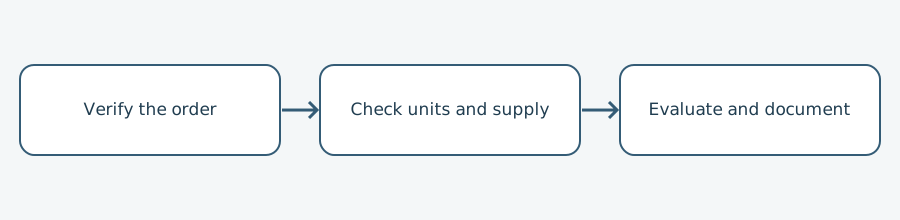
The original diagram separates three stages that are easily blurred in a memorized answer. Recognition identifies the relevant observation. Action uses the verified plan and the clinician's professional role. Evaluation asks whether the intended response actually occurred. Completing a task, administering an intervention or passing responsibility to another team member does not itself establish a safe outcome. The following original case comparisons make those distinctions explicit without pretending to reproduce an official NCLEX case study.
One-time syringe use
A used syringe appears clean and someone suggests saving it for another patient. Safe injection practice prohibits using the same syringe for different patients. The one-time rule applies to the syringe and needle, not merely to the part that visibly contacted the person.
The justified response is: Discard the used syringe and needle and obtain a new sterile set for the next patient. Compare that with the proposal to reuse the syringe through another length of IV tubing because the tubing prevents direct contact with the patient. The contrast matters because intervening tubing does not make cross-patient reuse safe.
PAUSE & TRYWhat uncertainty or observed cue controls this decision?Reveal explanation
Relevant cue: A used syringe appears clean and someone suggests saving it for another patient. Safe injection practice prohibits using the same syringe for different patients. The one-time rule applies to the syringe and needle, not merely to the part that visibly contacted the person.
Single-dose vials
A clinician suggests using one single-dose container for two patients. A single-dose label defines an important use limit. Do not infer that excess volume permits sharing, pooling or later reuse; consult pharmacy for appropriate sterile preparation processes.
The justified response is: Use the single-dose container for one patient and discard leftover contents according to the required procedure. Compare that with the proposal to retain the remainder for a different patient because the container holds more medication than one order requires. The contrast matters because a single-dose container is not a multidose supply.
PAUSE & TRYWhat uncertainty or observed cue controls this decision?Reveal explanation
Relevant cue: A clinician suggests using one single-dose container for two patients. A single-dose label defines an important use limit. Do not infer that excess volume permits sharing, pooling or later reuse; consult pharmacy for appropriate sterile preparation processes.
Questionable medication sterility
The sterility of an injection container is uncertain after handling. A medication container with questionable sterility is not used. Follow the relevant pharmacy and infection-prevention procedure rather than trying to visually certify sterility.
The justified response is: Discard the compromised vial using the required procedure and obtain an appropriate uncontaminated medication supply. Compare that with the proposal to clean the outside of the vial and assume the known contamination of its contents has thereby been reversed. The contrast matters because external cleaning does not reverse contaminated contents.
PAUSE & TRYWhat uncertainty or observed cue controls this decision?Reveal explanation
Relevant cue: The sterility of an injection container is uncertain after handling. A medication container with questionable sterility is not used. Follow the relevant pharmacy and infection-prevention procedure rather than trying to visually certify sterility.
Clean medication preparation
An RN sees contamination in the designated preparation area. Safe medication preparation protects sterility and stability. Use an appropriate preparation area and aseptic process; do not invent shortcuts to compensate for an unsuitable environment.
The justified response is: Use the designated clean medication preparation area with appropriate supplies and aseptic technique before drawing up the injection. Compare that with the proposal to leave a needle inserted in a vial between uses to make subsequent access faster and easier. The contrast matters because a retained needle creates a route for contamination.
PAUSE & TRYWhat uncertainty or observed cue controls this decision?Reveal explanation
Relevant cue: An RN sees contamination in the designated preparation area. Safe medication preparation protects sterility and stability. Use an appropriate preparation area and aseptic process; do not invent shortcuts to compensate for an unsuitable environment.
Handling multidose vials
A team member assumes a multidose preservative makes reuse with used equipment safe. A multidose vial that enters an immediate patient-treatment area must be dedicated to that patient only; moving it back does not restore shared-use eligibility. Permitted shared vials stay in a designated clean preparation area, and no vial is re-entered with used injection equipment.
The justified response is: If the vial enters an immediate patient-treatment area, dedicate it to that patient; permitted shared vials stay in a clean preparation area. Compare that with the proposal to share the vial after taking it into an immediate patient-treatment area because it is labeled multidose. The contrast matters because such a vial should be dedicated to that patient.
PAUSE & TRYWhat uncertainty or observed cue controls this decision?Reveal explanation
Relevant cue: A team member assumes a multidose preservative makes reuse with used equipment safe. A multidose vial that enters an immediate patient-treatment area must be dedicated to that patient only; moving it back does not restore shared-use eligibility. Permitted shared vials stay in a designated clean preparation area, and no vial is re-entered with used injection equipment.
Clarifying an ambiguous medication direction
A prescribed medication amount has an unclear unit. A medication discrepancy is resolved through the prescribing and pharmacy process before administration. Independently choosing an interpretation is not an appropriate substitute for a clear authorized order.
The justified response is: Clarify the ambiguous order through the prescribing or pharmacy process before administering the affected medication. Compare that with the proposal to administer the dose first and ask the prescriber afterward so the scheduled medication time is not missed. The contrast matters because an unresolved discrepancy can cause preventable harm.
PAUSE & TRYWhat uncertainty or observed cue controls this decision?Reveal explanation
Relevant cue: A prescribed medication amount has an unclear unit. A medication discrepancy is resolved through the prescribing and pharmacy process before administration. Independently choosing an interpretation is not an appropriate substitute for a clear authorized order.
Rechecking after oral correction
Symptoms improve after oral hypoglycemia treatment but no follow-up glucose has been checked. For an awake adult able to swallow and an applicable 15-15 protocol, rapidly absorbed carbohydrate is followed by a 15-minute glucose check. Continue the approved protocol when still below threshold and escalate when clinically indicated.
The justified response is: Recheck the actual glucose after the protocol interval, then follow authorized repeat or escalation instructions based on the result. Compare that with the proposal to stop monitoring immediately after carbohydrate has been given because administration alone establishes that the episode is corrected. The contrast matters because a treatment must be evaluated.
PAUSE & TRYWhat uncertainty or observed cue controls this decision?Reveal explanation
Relevant cue: Symptoms improve after oral hypoglycemia treatment but no follow-up glucose has been checked. For an awake adult able to swallow and an applicable 15-15 protocol, rapidly absorbed carbohydrate is followed by a 15-minute glucose check. Continue the approved protocol when still below threshold and escalate when clinically indicated.
Severe hypoglycemia with impaired self-treatment
An adult with severe hypoglycemia loses the ability to follow swallowing directions. A person who is unconscious or cannot swallow safely is not treated by forcing oral carbohydrate. Severe hypoglycemia requires prompt help and an authorized treatment pathway, with ongoing assessment.
The justified response is: Activate emergency support and the authorized severe-hypoglycemia pathway without forcing intake through an unsafe swallow. Compare that with the proposal to leave the impaired client alone while obtaining a routine meal rather than activating the severe-hypoglycemia pathway. The contrast matters because an impaired client needs immediate assistance and monitoring.
PAUSE & TRYWhat uncertainty or observed cue controls this decision?Reveal explanation
Relevant cue: An adult with severe hypoglycemia loses the ability to follow swallowing directions. A person who is unconscious or cannot swallow safely is not treated by forcing oral carbohydrate. Severe hypoglycemia requires prompt help and an authorized treatment pathway, with ongoing assessment.
Evaluating the response to an intervention
A client receives an intervention but the relevant symptom persists. Clinical judgment includes evaluating whether the intervention achieved its intended outcome. Compare the new observations with the goal and baseline, then revise or escalate through the authorized clinical process.
The justified response is: Reassess the relevant findings against the expected response and escalate a persistent or worsening problem. Compare that with the proposal to repeat an ineffective plan indefinitely without reassessment or escalation because the original order has not expired. The contrast matters because persistent problems require reassessment and possible revision.
PAUSE & TRYWhat uncertainty or observed cue controls this decision?Reveal explanation
Relevant cue: A client receives an intervention but the relevant symptom persists. Clinical judgment includes evaluating whether the intervention achieved its intended outcome. Compare the new observations with the goal and baseline, then revise or escalate through the authorized clinical process.
Rehearse the reasoning and name its limits
Use a mixed practice set after reading the comparisons. Before viewing feedback, state the cue, the selected action and what would need reassessment afterward. If a calculation is involved, write the units and use an independent arithmetic check. The fictional classroom quantities in this path do not authorize a real clinical dose. In an actual setting, the verified order, the person's assessment, applicable protocols and professional competence all remain necessary.
This resource is an independently authored foundation guide. It does not claim that every current NCLEX objective or formal item interaction is taught here. The site does not implement computerized adaptive testing, calibrated licensure probabilities, a full unfolding clinical record or official partial-credit scoring. The 2026 plan is a scope reference; no official examination question is reproduced. Clinical educator review and learner testing are still required before broader professional use.
Turn the idea into practice.
Apply the rule to a new case, then explain your choice.
Practice this skillSources & authorship
Original teaching using the current test-plan framework and official clinical safety references. Successful web-read captures and failed direct fetches are separately retained.
Independently authored cases, contrasts and diagrams; no official question or extended source passage reproduced.
Independent educator review is pending. This guide is not an official exam paper or a video transcript.
NCLEX current test plans and 2026 RN planCDC safe injection practicesCDC hypoglycemia treatment and reassessment