
Use original case comparisons to connect relevant cues, justified nursing actions and reassessment. This is foundation teaching, not an official examination simulation.
Build a reasoned response from the cue
A foundation question usually gives less information than a full clinical encounter. That limitation is a reason to read the supplied findings carefully, not a reason to invent the missing assessment. Begin by naming the cue that changes the decision: a new symptom, a contradiction, an inability to understand an instruction, a contamination event or an unresolved result. Ask what can be concluded now and what still needs the appropriate clinician or process. A familiar task can become a different problem when its circumstances change.
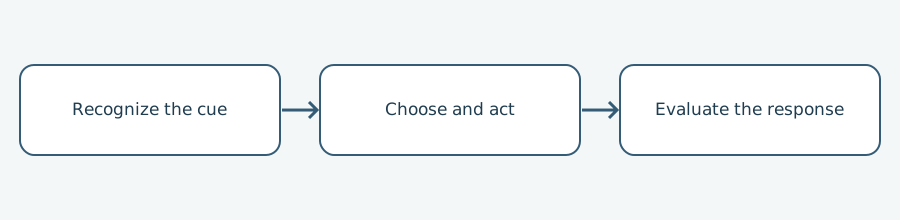
The original diagram separates three stages that are easily blurred in a memorized answer. Recognition identifies the relevant observation. Action uses the verified plan and the clinician's professional role. Evaluation asks whether the intended response actually occurred. Completing a task, administering an intervention or passing responsibility to another team member does not itself establish a safe outcome. The following original case comparisons make those distinctions explicit without pretending to reproduce an official NCLEX case study.
Handoff of unresolved concerns
A concerning trend has been escalated, but further instructions are still pending. A safe handoff distinguishes an observed cue, an interpretation, actions and the response. Explicitly identify pending results and unresolved needs so the receiving clinician can continue the plan.
The justified response is: State the current findings, actions already taken, and unresolved concern or pending result requiring follow-up. Compare that with the proposal to describe the intervention as successful before reassessing whether the relevant finding or symptom has actually improved. The contrast matters because a completed intervention does not prove an improved outcome.
PAUSE & TRYWhat uncertainty or observed cue controls this decision?Reveal explanation
Relevant cue: A concerning trend has been escalated, but further instructions are still pending. A safe handoff distinguishes an observed cue, an interpretation, actions and the response. Explicitly identify pending results and unresolved needs so the receiving clinician can continue the plan.
Conflicting care instructions
Two active nonurgent instructions specify incompatible preparation for a procedure. A discrepancy must be made explicit and reconciled through the appropriate team member. Check the current authorized plan and communicate the resolution rather than silently choosing an interpretation.
The justified response is: Resolve the conflicting instructions with the responsible clinician before performing the affected nonurgent intervention. Compare that with the proposal to combine the conflicting instructions into a new method without checking which current authorized plan should apply. The contrast matters because combining conflicting plans can produce an unassessed intervention.
PAUSE & TRYWhat uncertainty or observed cue controls this decision?Reveal explanation
Relevant cue: Two active nonurgent instructions specify incompatible preparation for a procedure. A discrepancy must be made explicit and reconciled through the appropriate team member. Check the current authorized plan and communicate the resolution rather than silently choosing an interpretation.
Interpreting a trend rather than an isolated number
A client has a new symptom despite one measurement inside its reference range. Risk recognition uses current symptoms, measurement quality, baseline and direction of change. A single reassuring detail does not erase a concerning pattern.
The justified response is: Compare the trend with baseline and symptoms, verify measurement quality, and escalate a concerning change. Compare that with the proposal to use a single number as a complete diagnosis without considering measurement quality, baseline or current clinical findings. The contrast matters because assessment requires context and relevant findings.
PAUSE & TRYWhat uncertainty or observed cue controls this decision?Reveal explanation
Relevant cue: A client has a new symptom despite one measurement inside its reference range. Risk recognition uses current symptoms, measurement quality, baseline and direction of change. A single reassuring detail does not erase a concerning pattern.
Closing the loop on pending results
A client asks about a result that is still unavailable. A diagnostic process is incomplete until relevant results are received, reviewed and communicated. Make the next responsible person and action explicit rather than allowing a pending result to disappear at a transition.
The justified response is: Track the pending result and explicitly communicate who will review it and what follow-up remains required. Compare that with the proposal to omit the pending result from transfer communication because the sample has already been collected and sent. The contrast matters because the receiving team needs to know the unresolved follow-up.
PAUSE & TRYWhat uncertainty or observed cue controls this decision?Reveal explanation
Relevant cue: A client asks about a result that is still unavailable. A diagnostic process is incomplete until relevant results are received, reviewed and communicated. Make the next responsible person and action explicit rather than allowing a pending result to disappear at a transition.
Checking procedure preparation
The planned procedure changes after preparation instructions were given. Procedure readiness combines the current authorized plan, relevant checks and the person's understanding. Identify and resolve missing information before a nonemergency procedure rather than silently making assumptions.
The justified response is: Verify the current preparation, understanding and required checks before the planned nonemergency procedure. Compare that with the proposal to use a remembered preparation rule without checking the actual procedure or the individual's current authorized instructions. The contrast matters because preparation differs among procedures and clients.
PAUSE & TRYWhat uncertainty or observed cue controls this decision?Reveal explanation
Relevant cue: The planned procedure changes after preparation instructions were given. Procedure readiness combines the current authorized plan, relevant checks and the person's understanding. Identify and resolve missing information before a nonemergency procedure rather than silently making assumptions.
Recognizing a potentially worsening infection
A client with an infection develops new confusion. An infection accompanied by new confusion, breathing difficulty, clammy skin or circulatory changes raises concern for serious deterioration. Prompt assessment and escalation are more appropriate than waiting for a complete symptom list.
The justified response is: Assess the new change promptly and escalate concern for possible systemic infection-related deterioration. Compare that with the proposal to treat new systemic symptoms as routine because the client already has an infection documented and treatment planned. The contrast matters because an existing infection can trigger systemic illness.
PAUSE & TRYWhat uncertainty or observed cue controls this decision?Reveal explanation
Relevant cue: A client with an infection develops new confusion. An infection accompanied by new confusion, breathing difficulty, clammy skin or circulatory changes raises concern for serious deterioration. Prompt assessment and escalation are more appropriate than waiting for a complete symptom list.
Time-sensitive symptom information
A family reports that unilateral weakness began earlier in the day. Acute stroke-like symptoms require urgent assessment. Onset or last-known-well information is valuable, but collecting it must not delay emergency action and uncertain details must not be fabricated.
The justified response is: Activate urgent assessment and communicate actual onset or last-known-well information without inventing unknown timing. Compare that with the proposal to omit all timing information because only the current neurologic finding can influence time-sensitive clinical decisions. The contrast matters because timing can influence time-sensitive evaluation and treatment.
PAUSE & TRYWhat uncertainty or observed cue controls this decision?Reveal explanation
Relevant cue: A family reports that unilateral weakness began earlier in the day. Acute stroke-like symptoms require urgent assessment. Onset or last-known-well information is valuable, but collecting it must not delay emergency action and uncertain details must not be fabricated.
New severe breathing difficulty
A client with an infection develops severe respiratory distress. A new severe breathing problem requires prompt assessment and the facility emergency process. Follow training and authorized protocols while obtaining qualified help; routine work does not take priority.
The justified response is: Immediately assess the new breathing difficulty and activate urgent support using the authorized emergency pathway. Compare that with the proposal to offer oral food or drink before obtaining help because comfort measures should precede evaluation of respiratory distress. The contrast matters because oral intake does not address respiratory compromise and may add risk.
PAUSE & TRYWhat uncertainty or observed cue controls this decision?Reveal explanation
Relevant cue: A client with an infection develops severe respiratory distress. A new severe breathing problem requires prompt assessment and the facility emergency process. Follow training and authorized protocols while obtaining qualified help; routine work does not take priority.
Urgent assessment of stroke-like symptoms
A client suddenly has weakness of one arm. Sudden focal neurologic changes are time-sensitive. Use the emergency pathway and preserve relevant timing information rather than seeking reassurance from an unrelated normal finding.
The justified response is: Activate the stroke or emergency pathway and promptly communicate the observed sudden neurologic change. Compare that with the proposal to give routine food or drink before assessing swallowing safety after the new neurologic change has occurred. The contrast matters because a new neurologic change can affect safe swallowing.
PAUSE & TRYWhat uncertainty or observed cue controls this decision?Reveal explanation
Relevant cue: A client suddenly has weakness of one arm. Sudden focal neurologic changes are time-sensitive. Use the emergency pathway and preserve relevant timing information rather than seeking reassurance from an unrelated normal finding.
Possible sepsis as an emergency
A client with a suspected infection becomes acutely short of breath and clammy. Sepsis is a life-threatening response to infection. New systemic deterioration warrants rapid clinical assessment and treatment through the relevant pathway, not a wait for a complete textbook picture.
The justified response is: Promptly assess and escalate possible sepsis through the appropriate emergency evaluation and treatment pathway. Compare that with the proposal to treat acute systemic deterioration as routine because a source of infection is already documented in the record. The contrast matters because known infection does not make systemic deterioration routine.
PAUSE & TRYWhat uncertainty or observed cue controls this decision?Reveal explanation
Relevant cue: A client with a suspected infection becomes acutely short of breath and clammy. Sepsis is a life-threatening response to infection. New systemic deterioration warrants rapid clinical assessment and treatment through the relevant pathway, not a wait for a complete textbook picture.
Rehearse the reasoning and name its limits
Use a mixed practice set after reading the comparisons. Before viewing feedback, state the cue, the selected action and what would need reassessment afterward. If a calculation is involved, write the units and use an independent arithmetic check. The fictional classroom quantities in this path do not authorize a real clinical dose. In an actual setting, the verified order, the person's assessment, applicable protocols and professional competence all remain necessary.
This resource is an independently authored foundation guide. It does not claim that every current NCLEX objective or formal item interaction is taught here. The site does not implement computerized adaptive testing, calibrated licensure probabilities, a full unfolding clinical record or official partial-credit scoring. The 2026 plan is a scope reference; no official examination question is reproduced. Clinical educator review and learner testing are still required before broader professional use.
Turn the idea into practice.
Apply the rule to a new case, then explain your choice.
Practice this skillSources & authorship
Original teaching using the current test-plan framework and official clinical safety references. Successful web-read captures and failed direct fetches are separately retained.
Independently authored cases, contrasts and diagrams; no official question or extended source passage reproduced.
Independent educator review is pending. This guide is not an official exam paper or a video transcript.
NCLEX current test plans and 2026 RN planCDC stroke warning signsCDC sepsis overview