
The source explains foundational factoring and zero-product reasoning. This original companion adds college-algebra applications and independent examples; the source does not teach every extension.
Factoring changes what you can see
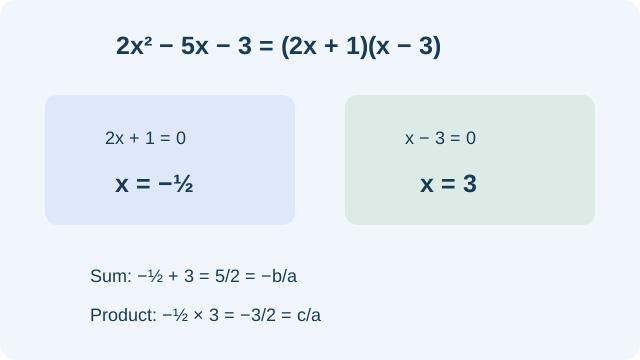
An expanded polynomial makes coefficients easy to identify, while a product of factors makes zeros easy to locate. Consider the original example p(x) = 2x² − 5x − 3. Its leading coefficient is two and its constant term is negative three. To expose its zeros, rewrite it as (2x + 1)(x − 3). Expanding that product gives 2x² − 6x + x − 3, which combines to the original expression.
The linked foundational video explains factoring and zero-product reasoning. This companion uses new examples and extends those ideas to rational expressions, excluded inputs and removable holes. Those extensions are independently authored college-algebra teaching material. The source is not presented as a CLEP lesson, an official question bank or evidence of this article's exam-specific coverage.
Set a product equal to zero
To solve p(x) = 0, one factor must equal zero. The factor 2x + 1 gives x = −1/2, and the factor x − 3 gives x = 3. These are the two roots. Notice that the positive one inside the first factor does not itself give a positive root; solving the short linear equation is essential. For the same reason, a factor x − 3 produces a positive root.
Check each result in the expanded expression. At three, the values are eighteen minus fifteen minus three, totaling zero. At negative one-half, they are one-half plus five-halves minus three, also totaling zero. This substitution checks both the factorization and the sign handling. The diagram marks both roots, while the vertical intercept remains p(0) = −3.
Extract a combined quantity efficiently
If a question asks for the sum of the roots, you may not need to find them separately. For ax² + bx + c, expanding a(x − r)(x − s) shows that r + s = −b/a and rs = c/a. In our example, the sum is five-halves and the product is negative three-halves. The roots three and negative one-half confirm both quantities.
The requested quantity matters. Five-halves is the sum, not an additional root. Similarly, the constant term negative three is not the product here because the leading coefficient is two. Coefficient comparisons are useful precisely when they preserve all of the factors. Before applying a shortcut, write the general form and identify a, b and c with their signs.
PAUSE & TRYFor 3x² − 12x + 9 = 0, what is the product of the roots?Reveal explanation
3. Divide c by a: 9/3 = 3. The roots 1 and 3 confirm it.
Cancellation does not restore an excluded input
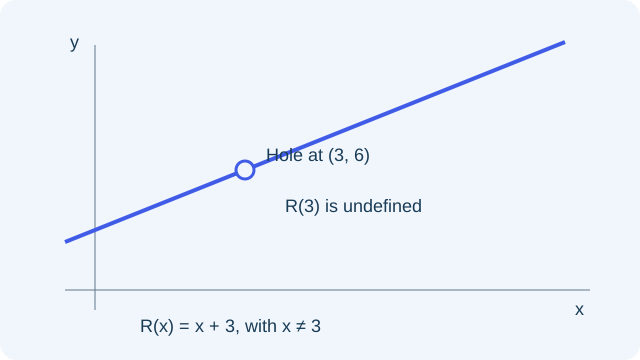
Now examine R(x) = (x² − 9)/(x − 3). The denominator excludes x = 3 before any simplification occurs. Factoring the numerator as (x − 3)(x + 3) allows you to cancel the common factor for every allowed input, giving R(x) = x + 3 with the restriction x ≠ 3. The restriction remains attached to the simplified rule.
At x = 4, both forms give seven. At x = 3, the original expression requires division by zero and is undefined. The simplified expression alone would give six, but it describes a different domain if the restriction is dropped. On a graph, R follows the line y = x + 3 with a hole at (3, 6). A hole is not a filled point or a zero of the function.
Keep factors separate from individual terms
Cancellation applies to a common factor of the entire numerator and denominator. It does not permit deleting matching-looking terms across addition. For example, (x + 3)/x equals 1 + 3/x for nonzero x; it does not equal three. A numerical check at x = 2 produces five-halves and immediately reveals the faulty cancellation.
One practical habit is to factor completely before crossing anything out. Then state the excluded values from the original denominator. If an equation contains rational expressions, any candidate solution must be checked against those exclusions after solving. Multiplying an equation by an expression that can be zero may produce a candidate that was never valid in the original problem.
Check the object and its domain together
A polynomial root, a rational function's zero and an excluded input describe different things. A zero makes an allowed output equal to zero. An excluded input has no output under the rule. For R above, negative three is a zero because the denominator is nonzero there and the numerator is zero. Positive three is excluded even though the numerator also vanishes there.
End each rational-expression solution with two checks: evaluate the requested quantity and verify that all used inputs belong to the original domain. This takes only a moment and catches mistakes that algebraic simplification alone misses. The article's arithmetic has been recalculated independently, while broader educator review remains pending. Use these examples as a foundation for further official-topic practice, not as a complete college-algebra course.
PAUSE & TRYWhich is a zero of R(x): −3 or 3?Reveal explanation
−3 is a zero; 3 is excluded from the domain.
Turn the idea into practice.
A fresh set will help you use the relationship with different numbers.
Practice this skillEvidence & editorial note
Foundational captions are reused from the existing SAT archive. The full caption track was read; full audiovisual review was not performed. CLEP-oriented extensions and all examples are original, not attributed to the video.
Original teaching, examples and SVG diagrams with a brief source synopsis and timestamp index.
Caption track SHA-256: e8cd3ef004b42dc23f0cfa85bd3314b2b7a16612426c002ce58f3d5ebed9efc2
Source segment references are retained in the catalog. Full captions remain in the local research archive.