
A reliable method
Compare first differences, second differences or ratios on equally spaced inputs. State the response quantity and units, then check a prediction against all available observations.
The common trap
A visually rising graph need not be exponential. Unequal input intervals make simple differences or ratios misleading.
Make the connection
A residual is observed minus predicted. Its sign and size help diagnose fit, but extrapolation can fail even when observed residuals are small.
Compare data and assumptions
At equally spaced inputs, outputs 2,6,18 have a constant ratio 3 but differences 4 and 12, supporting an exponential rather than a linear model. Outputs 1,4,9 instead have first differences 3 and 5 and second difference 2, supporting a quadratic pattern. A pattern from a few observations does not prove a unique real-world mechanism. If a model predicts 20 and the observation is 23, the residual is +3 under observed-minus-predicted convention. A small residual at measured inputs does not establish reliable predictions outside the observed range. Explain the model assumptions alongside the computed output.
Transfer, explain and check
Compare predicted values 5,8,11 with observations 5,9,13. Residuals are 0,1,2. Explain why their systematic increase suggests revisiting the model rather than declaring its errors purely random.
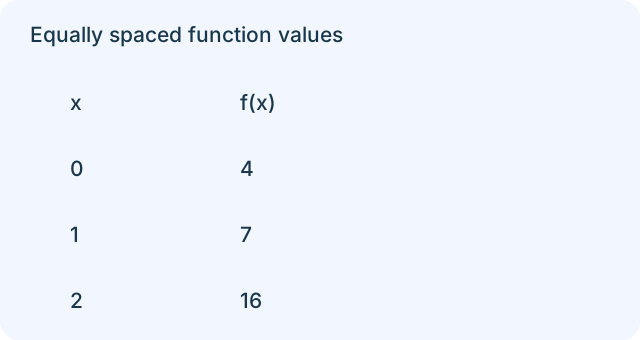
The table uses equally spaced inputs. What is its second difference?
 Open full-size diagram ↗
- The first differences are 3 and 9.
- Subtract the earlier first difference from the later one.
- The second difference is 9−3=6.
Compare the other answer choices
Report the second first difference rather than the second difference.
Add the first differences instead of subtracting.
Reverse the order of the first-difference subtraction.
Try it, then explain it.
Complete a short set without looking at the example. After each answer, explain which operation preserved the relationship and why the result makes sense.
Sources & authorship
Original Slope explanations and examples. References support the concepts; they are not the source of copied questions. Independent educator review is pending.
AP Precalculus course and syllabus