
The source works through quadratic equations using rearrangement, factoring and root checks. This companion uses that prerequisite idea to build original AP Precalculus reasoning. It is not a description of the current AP exam or a reproduction of the source lesson.
A target output is not always zero
Suppose P(x)=x²−6x+5 and you are asked when P(x)=5. The given polynomial factors as (x−1)(x−5), but its zeros do not answer this question. First subtract the target output: x²−6x+5=5 becomes x²−6x=0. Factoring gives x(x−6)=0, so the requested inputs are zero and six. Substitution into the original rule confirms that both outputs are five.
The source video introduces the prerequisite habit of rearranging before factoring. Our purpose here is to connect that habit to function language. Solving P(x)=0 finds intercepts with the horizontal axis. Solving P(x)=k finds intersections with a horizontal line at height k. The target output determines the equation you should factor.
PAUSE & TRYFor P(x)=x²−6x+5, which inputs give output zero?Reveal explanation
1 and 5. They are different from the inputs 0 and 6 that give output 5.
Read structure from the factored form
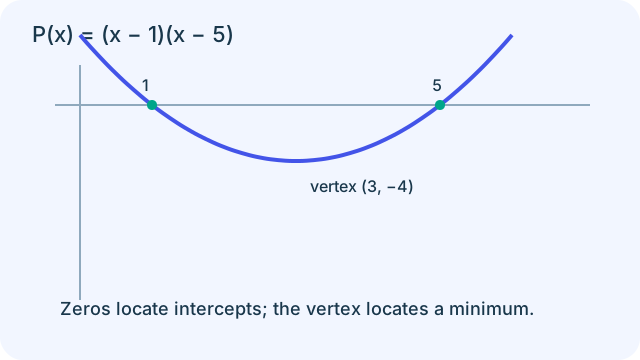
The expression P(x)=(x−1)(x−5) makes two zeros visible. The graph meets the horizontal axis at inputs one and five. Their midpoint is three; evaluating P(3) gives −4. Thus the vertex is (3,−4), and the quadratic can also be written as (x−3)²−4. Factored and vertex forms emphasize different features of the same rule.
A plot is useful for checking this story, but it should not supply an unstated assumption. Verify the vertex algebraically by expanding (x−3)²−4 to x²−6x+5. Verify the zeros by substitution. These two checks also show why the minimum value is negative even though both zeros are positive. An input coordinate and an output value play different roles.
Multiplicity changes behavior
Compare P with Q(x)=(x−1)²(x−5). Both have zeros at one and five, but the zero at one appears twice in Q. Near x=1, the squared factor is positive on both sides while x−5 remains negative. The product therefore stays negative across that zero, so the graph touches the axis rather than changing sign there.
Near x=5, the squared factor is positive and the remaining factor changes sign. The graph crosses at that zero. This local sign analysis is more informative than merely counting distinct roots. It also helps check a sketch without needing to evaluate dozens of points. A degree count includes multiplicity, whereas a list of distinct intercept locations does not.
Use remainders to verify a factor claim
The remainder theorem provides another bridge between expressions and values. Dividing a polynomial F(x) by x−r leaves remainder F(r). For F(x)=x³−4x²+x+6, evaluating F(2) gives 8−16+2+6=0. Therefore x−2 is a factor. Polynomial division then gives x²−2x−3, which factors as (x−3)(x+1).
Multiply the factors back out before relying on the result. The full factorization has zeros two, three and negative one. Their sum is four, matching the negative of the quadratic coefficient in the monic cubic. That coefficient relationship is a useful second check, but it does not excuse skipping the original substitution when a question asks whether a specific value is a zero.
A rational expression keeps its original restrictions
Now form R(x)=(x²−6x+5)/(x−1). The numerator factors, so the expression simplifies to x−5 for inputs other than one. The excluded input remains excluded. At x=1 the original denominator is zero, even though the simplified line would produce −4. The graph has a hole at the point that the simplified line would otherwise contain.
This is why canceling factors is different from deleting conditions. Record restrictions before simplifying, carry them through every later calculation and check them after solving an equation. The diagrams and examples in this article are original companions to a basic factoring video; they do not imply that the video covers the complete AP rational-function curriculum. To finish your own solution, state whether you found a zero, a target-output input, a vertex value or an excluded input. Those are distinct answers to distinct questions.
PAUSE & TRYWhat is R(4), and is R(1) defined?Reveal explanation
R(4)=−1. R(1) is undefined because its original denominator is zero.
Build a sign chart
Place the zeros one and five on a number line for P(x)=(x−1)(x−5). Test zero in the first interval: both factors are negative, so the product is positive. Test three in the middle interval: one factor is positive and one negative, so the product is negative. Test six in the last interval: both factors are positive. This sign chart explains where the graph lies above or below its horizontal axis. It also prepares you for polynomial inequalities, where reporting only the roots is incomplete. Keep endpoints separate from intervals, and use the original inequality to decide whether a zero should be included.
Turn the idea into practice.
A fresh set will help you use the relationship with different numbers.
Practice this skillEvidence & editorial note
Existing caption evidence is explicitly reused from the SAT pilot because these algebra prerequisites also support AP Precalculus. The teaching prose, examples and diagrams here are newly authored. Automatic captions can corrupt notation; examples are independently computed. Full audiovisual review remains pending.
Original exam-specific teaching companion with a brief source synopsis.
Caption track SHA-256: e8cd3ef004b42dc23f0cfa85bd3314b2b7a16612426c002ce58f3d5ebed9efc2
Source segment references are retained in the catalog. Full captions remain in the local research archive.