
The inspected early captions use an initial bacteria count and a later observation to establish an exponential rule and solve for its constant. The original teaching below uses different examples. Later derivative material is outside this companion’s AP Precalculus scope.
A multiplier needs a time unit
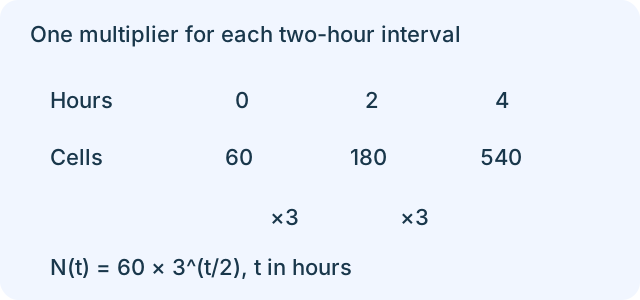
An original model for a laboratory culture starts with 60 cells and triples every two hours. A compact rule is N(t)=60×3^(t/2), where t is measured in hours. The exponent counts two-hour intervals, so N(0)=60, N(2)=180 and N(4)=540. Writing 60×3^t would triple the count every hour and would describe a different experiment. The unit attached to t is therefore part of the mathematics, not an optional label.
The source video’s early captioned segment demonstrates how an initial observation and a later observation determine an exponential expression. Its bacteria numbers and later calculus discussion are not reproduced here. Our examples focus on AP Precalculus modeling: translating a verbal change into a multiplier, checking observations and explaining what a logarithm recovers.
Compare a competing linear interpretation
The increase from 60 to 180 is 120 cells. A student might add 120 in every two-hour interval, obtaining 300 at hour four. That linear rule matches the first two observations but disagrees with the exponential prediction of 540. A third observation would help compare the models. Neither formula becomes scientifically justified merely because it is easy to calculate.
For equal input intervals, a linear model has a constant difference while an exponential model has a constant ratio. Check the spacing of the input values before applying that rule. Outputs 60,180,540 at hours zero, two and four have equal ratios of three. The same sequence at unequally spaced times would require a different analysis of growth per unit time. Name the interval whenever you explain a factor.
PAUSE & TRYFor N(t), what factor applies over four hours?Reveal explanation
9, because four hours contain two tripling intervals.
Recover a missing time with an inverse
Suppose the model reaches 1620 cells. Divide by the initial count before using a logarithm: 1620/60=27=3³. There are three two-hour intervals, giving t=6 hours. In general, solving N(t)=M for a positive target M gives t=2 log₃(M/60). The ratio inside the logarithm is dimensionless because both numerator and denominator count cells.
If the target is 120 cells, the ratio is two, which is not an integer power of three. The exact time is 2 log₃2 hours, approximately 1.262 hours. Rounding the logarithm prematurely can shift a later calculation, so retain its exact form or calculator precision until the end. Check that the answer lies between zero and two hours because 120 lies between the two corresponding model outputs, 60 and 180.
Translate bases without changing the model
An exponential function can be written with base e as well as with a period multiplier. Because 3^(t/2)=e^((ln 3)t/2), the same rule is N(t)=60e^(kt) with k=(ln 3)/2 per hour. This equality uses logarithm and exponent rules; it does not require taking a derivative. The constant k is not the two-hour multiplier three and should not be labeled a 300 percent increase.
The one-hour multiplier is √3, so the model’s percentage increase over one hour is 100(√3−1), approximately 73.2 percent. Over two hours the multiplier is three and the increase is 200 percent. A multiplier includes the retained original amount; an increase describes only the added amount. Keeping those two meanings separate prevents an apparently reasonable but incorrect percentage interpretation.
PAUSE & TRYDoes a multiplier of 3 mean 300% growth?Reveal explanation
No. It means the final amount is 300% of the original, an increase of 200%.
Reverse growth and test the domain
The same expression predicts N(−2)=20 cells. Algebraically the value is well defined, but a negative time may fall before the laboratory observations began. Report that as an extrapolation unless the model assumptions support it. Likewise, a positive exponential rule never reaches zero at a finite real time; asking a logarithm to recover a zero target would violate its positive-argument requirement.
For decay, consider a separate model A(t)=80×(1/2)^(t/3). It halves every three hours, so A(6)=20. The base is between zero and one, which reverses the direction of change while preserving the repeated-multiplication structure. Do not turn decay into a negative population or use a negative base for a positive quantity. Compare predictions with the plausible physical domain before giving a contextual conclusion.
Write a complete modeling response
A useful written response identifies the initial value, the period length and the growth or decay factor; writes a rule with units; checks a known observation; and explains a target-time calculation. These steps serve different purposes. A correct numerical answer without an explicit period can hide a model that only worked by accident for one input.
The video later develops derivative-based rates of growth. That material is outside the AP Precalculus scope of this companion and has not been presented as a required technique. This article is based on the inspected early captions and independently checked original examples. It does not claim full audiovisual review, and the source’s automatic captions may misrecognise symbols. Use the equations above for the mathematical argument and the linked early video segment for complementary explanation.
Turn the idea into practice.
A fresh set will help you use the relationship with different numbers.
Practice this skillEvidence & editorial note
Newly acquired real automatic captions; selected early caption text read in full. Original examples and illustration are independently checked. Later calculus content is excluded. Full audiovisual review remains pending.
Original teaching companion with a short source synopsis.
Caption track SHA-256: e49a81f8eb6cb8272a17c1128a92e64d34c5796e2c87787a409129acabcae5e6
Source segment references are retained in the catalog. Full captions remain in the local research archive.