
Room for pencil and paper.
Print a worksheet, or choose “Save as PDF” in your browser’s print dialog.
Mixed skills
10 original practice questions · Untimed · Fractions and exact decimals accepted
1. Find the area between the line segment shown and the x-axis from x=0 to x=3.
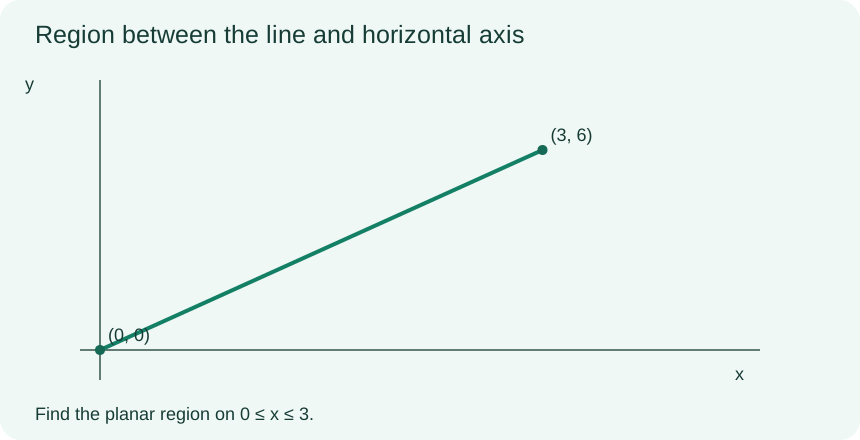 Open full-size diagram ↗
Optional written extension · self-assessment only
(a) Find the planar area. (b) Find the average height. (c) Rotate this region about the x-axis and find the volume.
Show your reasoning for each part. This task is not automatically scored.
2. If f(x)=2x³+4, find f′(3).
ab-derivatives-1-13. Evaluate ∫ from 0 to 2 of 2(8−2x)³ dx. Use the decreasing substitution u=8−2x.
ab2-decreasing-substitution-v24. On x²+y²=13, find dy/dx at (2,3).
ab-implicit-1-15. For f(x)=3|x−4|, what is the right-hand derivative minus the left-hand derivative at x=4?
ab-continuity-4-26. Using radian measure, find lim as x→0 of sin(5x)/x.
ab-limits-4-47. f(x)=x³ has inverse g. Find g′(8).
ab-implicit-4-18. y′=y² and y(0)=1/5. Find y(1) on the solution interval containing zero.
ab2-separable-reciprocal-v39. For f(x)=2sin(3x), find f′(0). Angles are in radians.
ab-derivatives-4-110. On y²=4x, find dy/dx at (25/4,5).
ab-implicit-2-3Answers & reasoning
1. 9 · Choice C
The upper function is the line throughout this nonnegative interval. Integrate 2x from 0 to 3. The area is 9 square units.
Optional written extension · self-assessment only
(a) Find the planar area. (b) Find the average height. (c) Rotate this region about the x-axis and find the volume.
- The area is (1/2)(3)(6)=9 square units. (1 points)
- Average height is 9/3=3 units. (1 points)
- The line has equation y=2x, so disk area is π(2x)². (1 points)
- The volume is π∫₀³4x²dx=36π cubic units. (1 points)
The area is (1/2)(3)(6)=9 square units.
Average height is 9/3=3 units.
The line has equation y=2x, so disk area is π(2x)².
The volume is π∫₀³4x²dx=36π cubic units.
2. 54 · Choice B
The power rule gives f′(x)=6x². The constant term differentiates to zero. Substitute 3: f′(3)=54.
ab-derivatives-1-13. 960 · Choice C
du=−2dx, while u changes from 8 to 4. The integral is −∫ from 8 to 4 of u³ du, or ∫ from 4 to 8 of u³ du. It equals ((8)⁴−4⁴)/4=960.
ab2-decreasing-substitution-v24. -2/3 · Choice C
Differentiate: 2x+2y(dy/dx)=0. Solve for dy/dx=−x/y. At the given point this is -2/3.
ab-implicit-1-15. 6 · Choice C
To the right the slope is 3; to the left it is −3. The nonzero difference shows that the derivative at the corner does not exist. The requested difference is 3−(−3)=6.
ab-continuity-4-26. 5 · Choice A
Multiply sin(5x)/(5x) by 5. The standard sine limit is 1 in radians. The product approaches 5.
ab-limits-4-47. 1/12 · Choice A
f(2)=8, so the corresponding x-value is 2. f′(2)=3(2)²=12. The inverse derivative is the reciprocal: 1/12.
ab-implicit-4-18. 1/4 · Choice B
Separate on the positive solution: y^(−2)dy=dx, so −1/y=x+C. The initial condition gives C=−5, hence y=1/(5−x) for x<5. Since 1<5, y(1)=1/4 is in that interval.
ab2-separable-reciprocal-v39. 6 · Choice B
The chain rule gives f′(x)=6cos(3x). Since cos(0)=1, evaluate at zero. The derivative is 6.
ab-derivatives-4-110. 2/5 · Choice A
Differentiate: 2y(dy/dx)=4. Divide by 2y, which is nonzero at y=5. The derivative is 2/5.
ab-implicit-2-3Original parameterized practice, independently checked by computation. Educator review pending. Not an official exam paper.