
Conditions before computation
For F(x)=∫₀ˣr(t)dt with continuous r, F′=r; where r is differentiable, F″=r′. Piecewise constant rates have jumps, so interval calculations and one-sided behavior are more appropriate at their boundaries. To find a largest amount, compare accumulated values at endpoints and rate sign-change candidates. If both integral limits move, subtract the lower-endpoint contribution. For an average over [0,x], the divisor x changes along with the integral.
Worked example with a method check
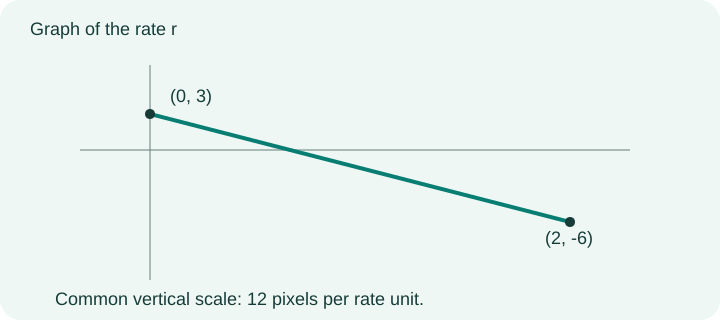
Let F(x)=∫ from 0 to x r(t)dt, with r(0)=3. The graph of r is the straight line segment through the labeled points. Find F″(1). Figure data (exact labels in reading order): Graph of the rate r | Graph of the rate r | (0, 3) | (2, -6) | Common vertical scale: 12 pixels per rate unit.. The FTC gives F′=r and therefore F″=r′ in the interior of this line segment. The slope of r is (-6−3)/(2−0). Thus F″(1)=-9/2. A rate graph’s slope controls accumulation concavity.
Compare two methods
A positive amount can be decreasing, and a positive rate can itself be decreasing. Those statements refer to F, F′ and F″, respectively. If r(t)=6−2t, then F is increasing before t=3 while concave down throughout: increasing does not mean concave up. For G(x)=∫ₓ²ˣt²dt, the upper contribution is 8x² and the lower contribution is x², giving 7x² rather than 3x².
Transfer: solve before reading
Let A(x)=x^(−1)∫₀ˣf(t)dt. If f(2)=5 and ∫₀²f=6, find A′(2) and interpret its sign. Why is the answer different from f(2)?
Transfer reasoning and answer
The quotient rule and FTC give A′(2)=[2·5−6]/4=1. The endpoint value 5 exceeds the current average 3, so extending the interval increases the running average. The derivative of the average accounts for both added accumulated output and the changing interval length; f(2) accounts only for the first.
Practice the next representation
Work all four task families linked to this lesson. For the illustrated items, state which numerical labels and relationships you used. For a written extension, compare each line of your solution with its original self-assessment criteria; these criteria are practice feedback, not an official AP score.
Let F(x)=∫ from 0 to x r(t)dt, with r(0)=3. The graph of r is the straight line segment through the labeled points. Find F″(1).
 Open full-size diagram ↗
- The FTC gives F′=r and therefore F″=r′ in the interior of this line segment.
- The slope of r is (-6−3)/(2−0).
- Thus F″(1)=-9/2. A rate graph’s slope controls accumulation concavity.
Compare the other answer choices
Reverse the slope sign.
Omit division by the horizontal interval length.
Find r(1), which is F′(1), instead of the slope of r.
Explain your thinking.
Optional written extension. Self-assessed only; it does not change your automatic practice result. These are teaching criteria, not official awarded marks.
(a) State the relationship or theorem that makes this calculation valid, including its relevant conditions. (b) Show the intermediate computation and give the requested result. (c) Explain why one plausible competing method would fail for this problem.
This draft stays on this page only. Use paper if you want to keep your working.
Try it, then explain it.
Complete a short set without looking at the example. After each answer, explain which operation preserved the relationship and why the result makes sense.
Sources & authorship
Original Slope explanations and examples. References support the concepts; they are not the source of copied questions. Independent educator review is pending.
AP Calculus AB and BC Course and Exam DescriptionCalculus Volume 1: Fundamental Theorem of Calculus