
The video recognizes a derivative factor within an integral, introduces u and its differential, integrates in the new variable and substitutes back. It ends by recommending a derivative check. The examples and definite-integral extensions here are original.
Look for a complete derivative factor
Substitution is most useful when an integrand contains an inner expression together with a factor proportional to that expression’s derivative. Looking only for a complicated parenthesis is not enough. The whole expression, including its differential, must be rewritten consistently. This distinction turns substitution from a guessing game into a checkable reversal of the chain rule.
The linked Khan Academy video develops this recognition process, introduces a new variable, carries its differential into the integral, and returns to the original variable after finding an antiderivative. Its automatic captions sometimes render exponents unclearly. This companion therefore does not reconstruct the source’s displayed formula from uncertain speech text. The polynomial examples, diagram and exercises below are independently authored and checked.
An original example with two independent routes
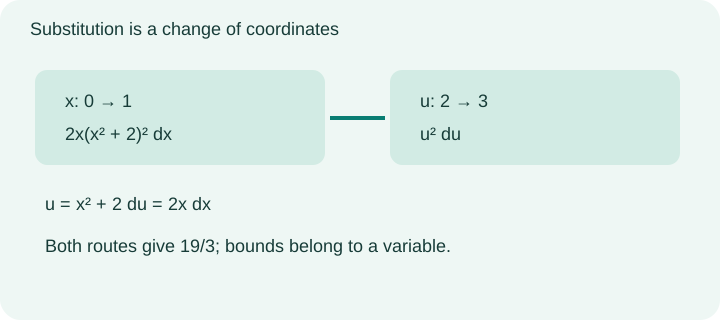
Consider I=∫₀¹2x(x²+2)²dx. Choose u=x²+2 because its derivative supplies exactly the factor 2x. Then du=2x dx. The starting input x=0 corresponds to u=2, and x=1 corresponds to u=3. Our entire integral becomes ∫₂³u²du. Its value is [u³/3]₂³=(27−8)/3=19/3. The two sets of bounds in the diagram describe the same endpoint inputs through different coordinates.
Check this result without using substitution. Expanding the original integrand gives 2x⁵+8x³+8x. Integrating term by term on [0,1] gives 1/3+2+4=19/3. The agreement tests the change of variables and the arithmetic through another method. Expansion is convenient for this example, but it can become cumbersome with larger powers and does not replace substitution for many other compositions.
Keep endpoints attached to their variable
A frequent mistake is to write ∫₀¹u²du after the substitution. That evaluates an integral over a different u-interval and produces 1/3. A symbol change inside the integrand does not change the meaning of the original endpoint numbers automatically. You must either transform both endpoints or return to an antiderivative expressed in x before substituting x=0 and x=1.
Both valid routes agree. An antiderivative in the original variable is (x²+2)³/3. Its endpoint difference is again 27/3−8/3. Notice that the differential factor was fully accounted for: differentiating this antiderivative produces 2x(x²+2)². Differentiation is also a useful check when no easy expansion exists, because it tests whether a missing constant or variable factor was silently lost.
A decreasing substitution needs two sign checks
Now evaluate J=∫₀¹2(6−2x)³dx. With u=6−2x, du=−2dx, and the u-values decrease from 6 to 4. Therefore J=−∫₆⁴u³du=∫₄⁶u³du. This gives (6⁴−4⁴)/4=260. The original integrand is positive throughout [0,1], so a negative result would immediately conflict with a qualitative check.
There are two related signs to track: the differential factor is negative, and the transformed bounds are in descending order. Reversing the limits introduces another negative sign. Writing these changes explicitly prevents a correct-looking but negative answer. The method does not say every substitution must be increasing; it says the transformation must be carried through consistently, including its orientation.
Recognize when the proposed substitution is incomplete
Compare I with K=∫₀¹(x²+2)²dx. The second integrand lacks the factor 2x. Setting u=x²+2 does not turn it directly into ∫u²du, because dx is not du. For this polynomial, expand instead: x⁴+4x²+4 integrates to 1/5+4/3+4=83/15. Choosing a different method is a mathematical decision based on the actual structure.
This comparison also gives a way to diagnose errors. If someone claims the same antiderivative for I and K, differentiate the proposed answer and compare it with each original integrand. The mismatch identifies the missing factor precisely. For an indefinite integral, remember the constant of integration; for a definite integral, the endpoint difference removes that arbitrary constant. These are related tasks with different requested outputs.
Write an explanation that can be reviewed
A short written solution should state the chosen u, its differential, the transformed bounds when applicable, and the resulting integral before evaluation. Finish with a check suited to the problem: differentiate an antiderivative, compare signs, or expand a manageable polynomial. Stating these intermediate relationships makes the work reviewable even when an arithmetic slip occurs.
Try ∫₀¹4x(x²+1)³dx. Here du=2x dx, so the remaining factor is 2 and the bounds become 1 and 2. The answer is 2[u⁴/4]₁²=15/2. Explain where the factor 2 came from and why the lower bound is one. This companion supports AP Calculus AB substitution practice; its examples and feedback are original learning material, not official exam questions or an official scoring rubric.
PAUSE & TRYEvaluate ∫₀¹4x(x²+1)³dx, showing the differential factor and transformed bounds.Reveal explanation
u=x²+1, du=2x dx, so 4x dx=2du; bounds 1 and 2. Thus 2[u⁴/4]₁²=15/2.
Turn the idea into practice.
A fresh set will help you use the relationship with different numbers.
Practice this skillEvidence & editorial note
Actual English automatic captions acquired and all segments read. Synopsis and time navigation are source-grounded; all worked examples, diagrams and exercises are independently authored. Caption notation may be imperfect; no uncertain source equation is reconstructed. Full audiovisual and independent educator review remain pending.
Caption track SHA-256: b8022a46d5dcea404276db976fbef7a5f348b2de63f6e773e6951c769105103b
Source segment references are retained in the catalog. Full captions remain in the local research archive.