
The video introduces the chain rule by separating an outer operation from its inner input, then multiplying their derivative contributions. It uses trigonometric composition and discusses the intuition and limitations of treating differential notation like fractions. The polynomial examples and product-rule extensions below are independently authored.
Read the nesting before choosing a rule
The chain rule begins with a structural question: which operation happens last? In h(x)=(3x+1)², the input is first multiplied by three, then increased by one, and finally squared. The outer function squares its input. The inner function produces that input. Naming these two functions turns a complicated-looking expression into two smaller derivative tasks.
Compare this with p(x)=x²(3x+1). Here the last operation is multiplication of two functions, so the product rule is the first rule needed. Both expressions contain a square and a linear expression, but their grouping changes the mathematics. Before touching coefficients, point to the outermost operation in the notation. Parentheses are mathematical information, not decoration.
Differentiate one layer at a time
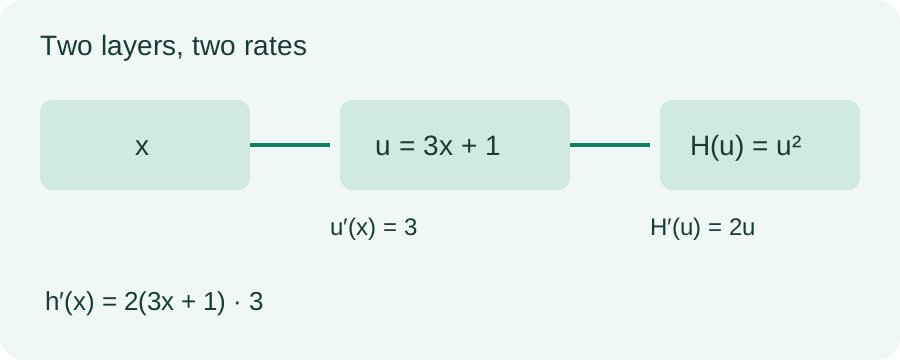
For our original example h(x)=(3x+1)², define u(x)=3x+1 and H(u)=u². The derivative H′(u)=2u describes how the outer function changes when its own input u changes. The derivative u′(x)=3 describes how quickly that inner input changes with x. Multiply these rates after evaluating the outer derivative at the original inner function.
This gives h′(x)=2(3x+1)·3=6(3x+1). At x=2, the derivative is 42. A common incomplete answer is 2(3x+1), which differentiates the outer square but acts as though the inner input changed at rate one. Another incorrect answer is 2·3=6, which replaces the inner expression with its derivative inside the outer derivative. The correct rule retains the inner function in the outer derivative and also multiplies by the inner derivative.
Use expansion as an independent check
Because h is a polynomial, we can check the derivative through a different route. Expand (3x+1)² to get 9x²+6x+1. Differentiating term by term gives 18x+6, equal to 6(3x+1). At two, both forms give 42. Expansion is a useful check here, but it becomes inefficient for a high outer power and is unavailable for many trigonometric or logarithmic compositions.
An independent check should test the calculation rather than repeat exactly the same steps. You can compare algebraically equivalent forms, use a small difference quotient as an approximation, or reason about signs. If the inner function is increasing and the outer function is increasing on the relevant inputs, a negative derivative should prompt a review. A sign check does not prove the exact coefficient, but it can identify an impossible result.
Keep product and chain rules working together
Now examine q(x)=x(2x+1)². The outermost operation is a product. Its derivative is one times the squared expression plus x times the derivative of that expression. Within the second term, the chain rule is needed because the square receives the input 2x+1. Thus q′(x)=(2x+1)²+4x(2x+1). At x=1, the two contributions are nine and twelve, giving twenty-one.
This example explains why naming only one rule can be insufficient. The product rule organizes the large expression; the chain rule handles a nested piece. Expanding first gives q(x)=4x³+4x²+x and hence q′(x)=12x²+8x+1. The result at one is again twenty-one. If you keep only the first product-rule term, you obtain nine; keeping only the second yields twelve. Each wrong value corresponds to a specific missing contribution.
Treat notation as a guide, not an unsupported proof
The source video explains an outer derivative with respect to an inner expression, then multiplies by the derivative of that expression with respect to x. It also cautions that treating differential notation as ordinary fractions is an intuition rather than a rigorous proof of the rule. In this companion, the named functions H and u make the composition explicit without relying on formal cancellation.
The differentiability conditions matter. The inner function must be differentiable at the input in question, and the outer function must be differentiable at the corresponding inner value for the usual chain-rule theorem to apply. For example, a square root imposes a domain condition, and its derivative formula requires a strictly positive inner value when used in the familiar reciprocal-square-root form. Checking the input is part of the solution.
Practise explaining the missing factor
Try r(x)=(x²+2)³. The outer cube contributes 3(x²+2)², and the inner quadratic contributes 2x. Therefore r′(x)=6x(x²+2)², which equals 54 at x=1. If a learner writes 3(x²+2)², explain that the missing factor measures the rate at which the input of the cube changes. Identifying the cause is more useful than simply announcing that an answer is wrong.
For a short written response, name both layers, state the chain-rule expression before simplifying, and evaluate only at the end. Then use one independent check, such as expansion or a qualitative sign prediction. These exercises support the computational component of AP Calculus AB, but a complete official free-response solution may also require interpretation, justification or a connection to a graph. The criteria here are original self-assessment guidance, not an official scoring rubric.
PAUSE & TRYFor r(x)=(x²+2)³, identify the two layers and calculate r′(1).Reveal explanation
Inner u=x²+2, outer H(u)=u³. The derivative is 3(x²+2)²·2x; at x=1 this gives 54.
Turn the idea into practice.
A fresh set will help you use the relationship with different numbers.
Practice this skillEvidence & editorial note
Actual English automatic captions acquired and all segments read. Captions can obscure placement of exponents; no source formula is reproduced from uncertain caption notation. Polynomial examples, diagrams and self-checks are original and independently checked. No full audiovisual review or educator sign-off. Replaces the second FTC companion to broaden subject coverage.
Caption track SHA-256: 36b552a8336bc1f3a0b7d9a55942ed30e9815dab781bfa7e554477abb2683124
Source segment references are retained in the catalog. Full captions remain in the local research archive.